
 Vedic Knowledge
Navagraha Homam Benefits: Who Should Perform It & Why
Navagraha Homam, being a time-tested Vedic Astrology’s most holistic remedy, is believed to bring Career Growth, Financial Stability,…
calendar_today Jul 12, 2026
 Book Griha Pravesh Puja Online Book Now
Imagine knowledge so massive, so limitless, that a single mind can not achieve it. Imagine voices from thousands of years ago – men and women who meditated in Himalayan forests, on riverbanks, and beneath open skies.
Listening to the universe itself and changing what they heard into words. This is what the story of the Vedas tells.
Vedas are the ancient spiritual texts in human history, written in Vedic Sanskrit and revered by hundreds of millions of people around the world.
But one doubt has fascinated scholars, believers, and curious minds for ages. Who wrote the Vedas? The answer is not easy – this is exactly what makes it beautiful.
There are two structures to this truth. Vedas are considered to be divine revelations on the spiritual level, not the product of any human mind.
They were composed and preserved by the lineage of extraordinary sages on the historical level that were called Rishis.
Later, it was compiled into the form we know today by the great sage Ved Vyasa.
In this blog, you will find who these rishis are, what everyone contributed, and how their knowledge survived millions of years to reach you today.
Before knowing the authors of the Vedas, it helps to know what exactly we are talking about. The Vedas are unlike any other book ever composed.
The term Veda comes from the Sanskrit word Vid, which means ‘to know.’ So literally, Veda means Knowledge – not simple knowledge, but the profound, most sacred knowledge of existence itself.
In a conventional way, the Vedas are not just a religious text. They are a huge source of hymns, rituals, philosophy, and cosmic details that made the very foundation of what we know as Hinduism today.
There are Four Vedas, each of which has its unique purpose:
All of the four Vedas are then categorized into four layers: Samhitas (hymns), Brahmanas (ritual commentaries), Aranyakas (forest treatises), and Upanishads (philosophical dialogues).
The scriptures are divided into two categories in the Hindu tradition: Smriti and Shruti. Smriti means ‘one which is remembered’ – texts composed and passed down by human beings.
Shruti means ‘one which is heard’. Vedas are shruti. They were not authored through human intellect but were heard – received by sages who had uplifted their consciousness to a point where cosmic truth became audible.
Thus, it’s not a metaphor in Hindu culture, but the defining truth about the scriptural texts.
This is the key question that deserves a complete, honest answer.
Vedas in the Hindu tradition are known as apauruṣeyā, meaning authorless. This is a Sanskrit term that means ‘not of a man’ or ‘without a human author’.
For the orthodox Hindu thinkers, the Vedas are the revelations received by the ancient sages after prolonged meditation, truths existing outside any human mind, waiting to be discovered.
What a radical idea this is!
The Vedas were not composed by the sages like a poet composes a poem. They were given an antenna that receives a message.
All this knowledge existed and was already embedded in the fabric of life. The Rishis were just vessels with pure enough energy such that they could perceive it.
The Vedas were created by the cosmic creator Brahma himself in the Hindu epic Mahabharata. In many ways, the Vedic hymns are interpreted as the sound of the breath of Brahma.
The Vedas were created over many centuries by a large community of sages known as the Rishis from a historical point of view.
The sages were able to discover these old truths through profound meditations, and then, in turn, they developed the teachings of these truths into hymns and chants in Sanskrit.
These were handed down from teacher to student, orally, from generation to generation, until they were finally collected by the great sage Vyasa.
It’s important to note that these two answers are not at odds with each other. The spiritual answer relates to the source of knowledge.
The historical answer addresses the “human instruments” through which that knowledge was transmitted into the world. Both are true.
The term Rishi is one of the most significant words in all Vedic civilizations. Knowing about the rishis is the key to knowing the Vedas themselves.
The term Rishi literally means ‘one who can see.’ A rishi was a motivated sage to whom the hymns of the Vedas were shown through deep spiritual insight.
What makes Rishi different from an ordinary person is not only their learning or scholarship. It was about
Hence, every mantra starts with three details;
Rishi was always honored first as the original receiver of the transmission.
The rishis achieved knowledge through intense spiritual practice called Tapasya. It consists of meditation, breath control, complete withdrawal from worldly distraction, and austerity.
With the practice, sages elevated their consciousness until they could know the realities invisible to the ordinary mind.
Hence, Vedic mantras are not just poetry. Every sound, syllable, metre brings a particular energy that rishis first heard in deep penetration, and then composed into language with extraordinary accuracy. The Vedas are the oldest body of experiential knowledge.
One of the most discussed facts about the Vedas is that women were also the composers of the Vedas. These female sages are called Rishikas, and are named within the Vedas themselves.
The Saptarishis are the honored personalities in Indian culture who were immortalised in the night sky.
The constellation of the Big Dipper (Ursa Major) in ancient Indian astronomy was called Saptarishi, with its seven stars showing seven rishis.
They were named as Vashistha, Marichi, Pulastya, Pulaha, Atri, Angiras, and Kratu. The wife of Rishi Vashishta, Arundhati, also has a star beside them – a small, barely visible point of light.
Multiple ancient texts offer a slightly different list of the rishis. The Jaiminiya Brahmana Names: Agastya, Bharadwaja, Gautam, Jamadagni, Atri, Vashistha, and Vishwamitra.
The Brihadaranyaka Upanishad lists: Atri, Gautama, Jamadagni, Kashyapa, Bharadwaja, Vashistha, and Vishwamitra.
These lists are slightly different and significant. It shares with us that Vedic customs were rich, diverse, and shared by multiple lineages of spiritual practitioners.
But what was their role in preserving and composing the Vedas?
Every saptarishi is connected with a particular Mandala (book) of the Rigveda called the Family book. These were the oldest parts of the Rigveda, and bear the names of sage families who composed and protected them.
The second book belongs to the Gritsamada family, the third to Vishwamitra, the fourth to Vamadeva, the fifth to Atri, the sixth to Bharadwaj, the seventh to Vashishtha, and the eighth to Kanva and Angiras.
Let’s know the individual sages, the human voice behind the ancient divine knowledge.
Rishi Vashishtha is the lead composer of Mandala 7 of the Rigveda and the royal pandit of the solar dynasty – the lineage of Lord Ram. Adi Shankara named him the first sage of the Vedanta school.
He started as a Kshatriya king and fought for himself, through ages of fierce tapasya, to the title of Brahmarishi. He has the highest rank in the Vedic order. Also wrote the Gayatri Mantra, still recited by millions every single morning.
Sage Agastya and his wife Lopamudra composed hymns 1.165 to 1.191 of the Rigveda. He is equally honored in Tamil culture as the father of Tamil literature. The star Canopus is named Agastya, the brightest star visible in the southern sky.
He is the most discussed Rishi in the Rigveda with 87 hymns to his name, and the complete fifth Mandala is named after his family.
Rishi Bhardwaj was the master of the Rigveda and an expert in medicine, warfare, and statecraft. His recognition crossed tradition completely; Lord Buddha himself named him one of the ten great early creators of verses.
He is the sage who is most closely connected to Agni, the god of fire, and his composition plays an important role in the Atharvaveda. His lineage, the Angirases, went on to form Bhardwaj and Brihaspati (the celestial teacher of the gods).
Rishi Kashyapa is known as the father of all living beings; from his union with the daughters of Daksha were born the gods, demons, animals, humans, and serpents.
He is the father of Vedic Astrology and the author of the Bhrigu Samhita. An astrological text said to attain the destiny of limitless souls.
Vyasa is also called Veda Vyasa (one who classified the Vedas) or Krishna Dvaipayana. He is traditionally revered as the composer of mantras of the Vedas into the four texts we know today.
He is also credited as the compiler of eighteen puranas, the Brahma sutras, and the greatest epic poem in human history, the Mahabharat. It includes the Bhagwat Gita.
Ved Vyasa is known by multiple Hindus as a partial form of Lord Vishnu. He is one of the Chiranjivis, the immortals. This is believed by the tradition to still be alive in the present day of Kali Yuga, continuing to lead humanity from a state of hidden existence.
As per the Hindu tradition, there was originally a single Veda- a unified body of knowledge called just the Veda.
Ved Vyasa saw that in the approaching time of Kali yuga, human lifespans and memories would be shortened dramatically. People will no longer have the ability to study and remember the complete Veda as a single unit.
So he decided to classify the one eternal Veda into four separate books – Rigveda, Samveda, Yajurveda, and Atharvaveda.
All of them were assigned to a primary student for protection. Paila received the Rigveda, Vaishampayana got the Yajurveda, Jaimini received the Samveda, and Sumantu got the Atharvaveda.
This act of classification is why he is called Ved Vyas: the ‘splitter of the Vedas’.
Apart from the Vedas, he also contributed to humanity by authoring the Mahabharat, around 1.8 million words, the longest epic poem ever written in any language.
The Bhagwat Gita lies in the Mahabharat. He even authored the Brahma Sutras – the foundational text of Vedanta philosophy, which reconciles all the learnings of the Upanishads.
To honor one’s teacher, Guru Purnima is celebrated on Vyasa’s birthday, a testimony to how deeply the Hindu tradition knows him as the original guru of all humanity.
The Vedas were preserved orally, from teacher to student, from mouth to ear, for thousands of years without any words being written. This is not a system of rote memorisation – Gurukula.
The students were living with their teachers and memorizing each syllable, each pitch, each breath of the text for years.
The Rishis devised a series of very accurate preservation instruments to ensure that nothing would ever be lost or misinterpreted.
It is estimated that the oldest Rigvedic hymns date from around 1500–1200 BCE, though the Vedas were not written down until much later, perhaps the first few centuries of the Common Era, when the palm leaf manuscripts were used.
The oral tradition continued even then. To this day, communities of Vedic scholars, known as Ghanpathis, are continuing to recite the complete Vedas (the four Vedas) aloud, an unbroken chain of which can be traced back thousands of years.
It is now possible to access the wisdom of the Vedas because they were composed by real people: Vishwamitra, Vashistha, Agastya, Atri, and dozens of others. These were not God’s distant gods.
They were seekers who fought, doubted, and never gave up on asking until they got a response from the universe. Vishwamitra started as an egoistic king.
Agastya spread sacred knowledge to a continent. Vashishta sacrificed 100 sons without any hesitation. They are not mythological entities, but they represent what an average person could be.
And neither have they lost touch. Vishwamitra has composed the Gayatri Mantra, which is recited by millions of people every morning. Vashistha’s words are still heard during Vedic Wedding Ceremonies.
If you chant a mantra today, as is done in a temple, at a wedding, or in a yoga class, you are singing with hundreds of voices of other human beings that go back thousands of years.
So, the Vedas were not the authorization of one mind or one moment. They are the collective breath of civilization – of rishis who meditated, emptied themselves of ego, and listened until the cosmos spoke.
To ask who wrote the Vedas is to find that behind every hymn, every mantra is a human story.
The story of longing, of effort, of extraordinary dedication to truth. Hence, that discovery makes the Vedas not just ordinary but more amazing.
The next time you hear a Vedic mantra in a temple, at a wedding, or in a meditation class, you are hearing the voice of sages who lived thousands of years ago, still speaking through time. The chain has never broken, but somehow, it reaches you.
Table Of Content
Expert and trusted pandits available for every puja, ritual, ceremony, and celebration
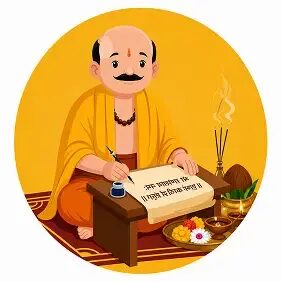
The Vedas, as per the Hindu tradition, are not written by humans. They are believed to be Apauruseya, the divine, authorless revelation attained by ancient sages, revered Rishis. Ved Vyasa later composed them into the four Vedas.
The Vedas originally were completely oral and then composed, memorised, and transmitted through chanting. It passed from teacher to students for ages before writing.
The sages estimate the oldest Rigvedic hymns were compiled around 1500-1200 BCE, and transmitted orally for centuries before being written.
Originally, the Rigveda was authored by multiple rishis, mainly around the Mandalas 2-7. The main composers were Gritsamada (Mandala 2), Vishwamitra (Mandala 3), Vamadeva (Mandala 4), Atri (Mandala 5), Bharadwaja (Mandala 6), and Vashistha (Mandala 7). Mandala 1 and 8–10 include hymns from many other rishis.
Yes, female sages known as Rishikas compiled hymns in the Vedas. They are Lopamudra, wife of Agastya, who is a named writer in the Rigveda. Other women's sages are Gargi Vachaknavi and Maitreyi, both of whom are involved mainly in Vedic philosophy.


 Ontime Service
  Certified Pandit
  Transparency