Panchamukhi Hanuman Ji: Story & Significance of Five-Faced Form
Lord Hanuman is one of the most revered deities in the Hindu mythology. Panchamukhi Hanuman Ji is one of the…
 0%
0%
 Book Griha Pravesh Puja Online
Book Now
Book Griha Pravesh Puja Online
Book Now



What does true bravery or courage seem like? As today’s youth are frequently put to the test to overcome their difficulties, the tale of Abhimanyu Chakravyuh from the Mahabharat is a lesson of fearless, brave, and fearless spirit.
Just a little boy of sixteen, he faced the most complicated war formations of the world, Chakravyuh.
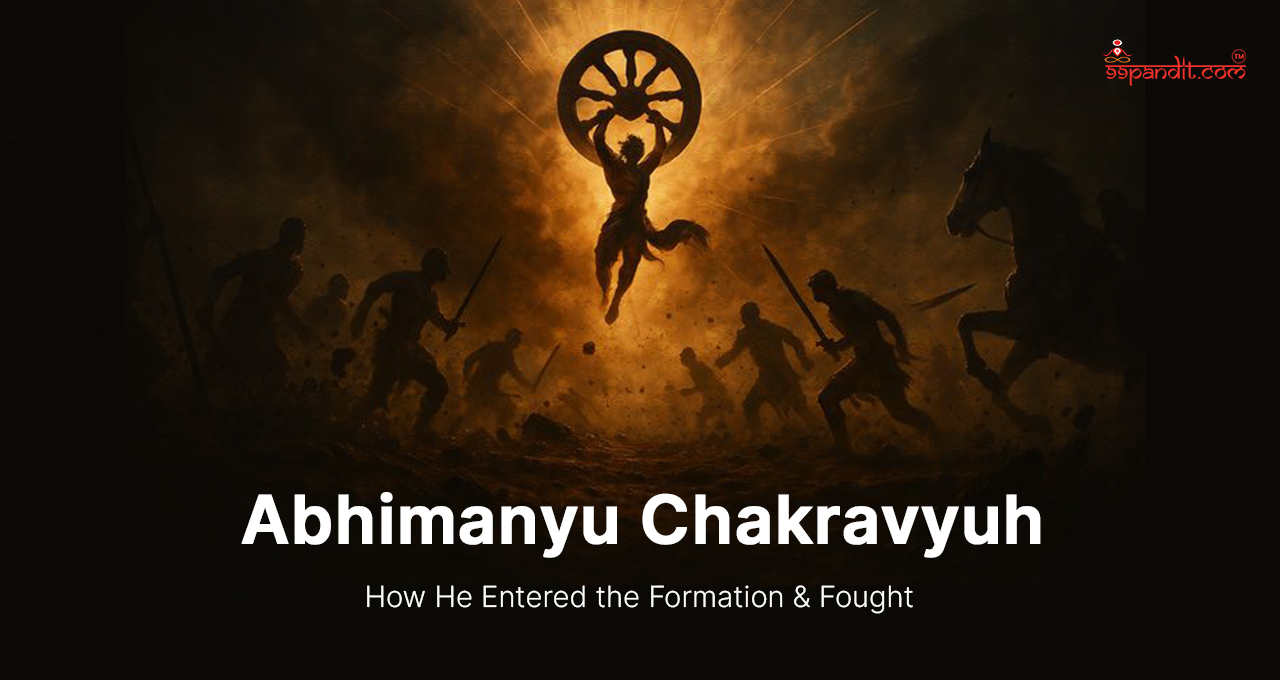
A trap where several heroes would hesitate to get caught, he was full of confidence and extraordinary courage.
Despite being unaware of the way out of the trap, he still decided to carry out his duty rather than be controlled by fear.
The story of Abhimanyu Chakravyuh is forever engraved in the memory of humanity as it conveys the message of dharma, sacrifice, and duty.
His death on the 13th day of the Kurukshetra war, Abhimanyu’s sacrifice, is the moment that marks the ethical downfall of the Kauravas and the cause of the Pandavas’ strong retaliation.
Let’s dive in deeper through the Abhimanyu Chakravyuh incident to know more and how it shapes the course of war ahead.
Abhimanyu was a second-generation warrior who was legendary in the Mahabharat. He was the son of Arjuna (amongst the best archers) and Subhadra, a sister of Lord Krishna.
His exceptional talent, courage, and intellect at a very young age make him stand out from the other warriors.
He is considered the incarnation of Vrachas, who is the son of Chandra Dev (the Moon God). According to the old scriptures like the Harivamsa Purana, Chandra Dev allowed Abhimanyu to exist on the planet as long as 16 years.
Thus, the kind of condition fits into his chronicle of life and death during the Kurushetra war.
Abhimanyu was also among the few, together with his father, who were familiar with the technique of entering the Chakravyuh, one of the potent military formations.
The sacrifice and courage of Abhimanyu made him an eternal hero who continues to inspire generations.
The word “Chakarvyuh is derived from the Sanskrit language, where “Chakra” refers to a circle and “Vyuh” means the battle formation.
When combined, Chakarvyuh refers to the deadliest wheel formation designed by the military, which is almost impossible to break.
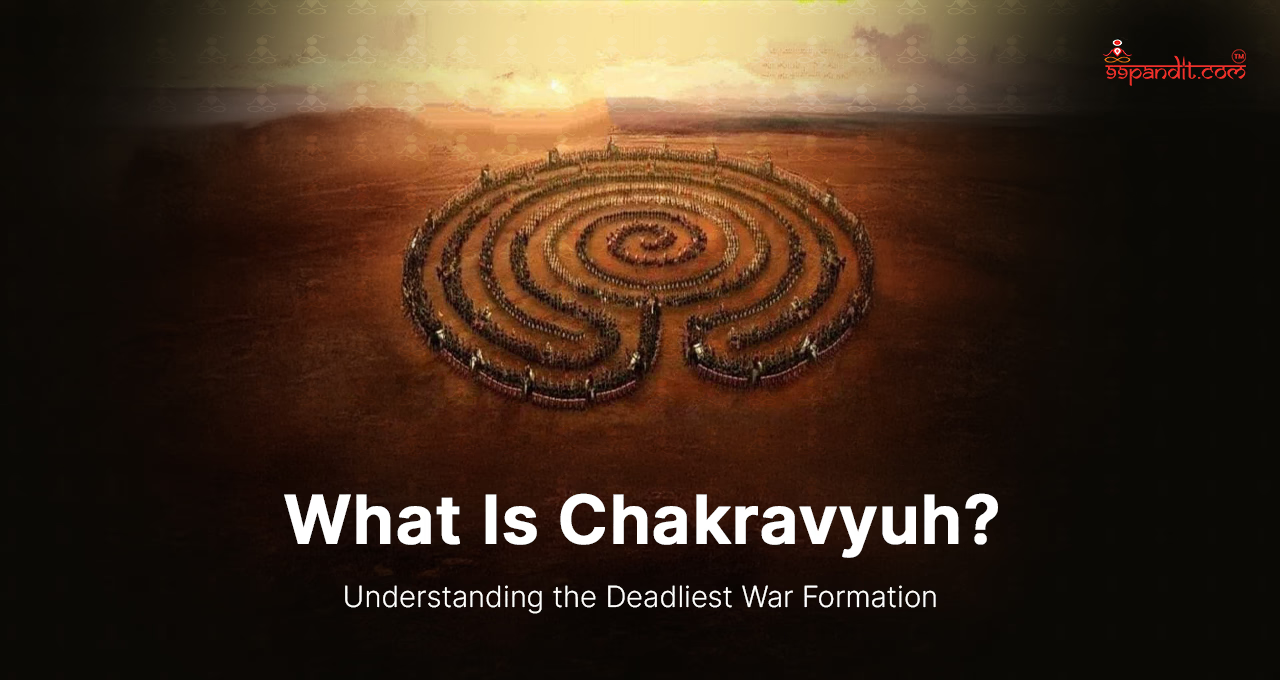
Particularly designed during the Kurushetra war to trap, confuse, and destroy the enemy.
Structure & key features of the Chakravyuh:
Purpose and function:
Why was it nearly impossible to break?
The Abhimanyu Chakravyuh symbolises the advanced military thinking during ancient warfare. Its unique and deadly design makes it difficult for even the greatest warriors to face this.
The 13th day of the Kurukshetra war is a turning point on the battlefield. It is when the Dronacharya, with the Kaurava, deployed the Chakravyuh as a calculated move and strategy.
At that moment of war, Dronacharya realized the growing momentum of the Pandavas’ army and the requirement to break it anyhow.
He knew that among all, only Arjuna and Lord Krishna understood the Chakravyuh thoroughly.
It is an ideal time for him to the advantage of the situation as Arjuna, along with Lord Krsihna, was away from the battlefield to stop the Smaspataks (a large army from the Trigata kingdom).
Consequently, the Kauravas and Dronacharya seized the opportunity to attack the Pandava army and dared them to breach the barricade.
As Arjuna was not on the battlefield, Abhimanyu was the only fighter of the Pandava side who had the knowledge of the way to get through it.
With no other option, he took responsibility on his shoulders and decided to break into the formation. Doroncharya already knew that he only knew a way to enter, not the exit.
Being purposefully drawn away from the battlefield, the Arujna does not know about any of this.
Additionally, the absence of the other warriors, such as Bhim, Yudhisthira, Nakula, and Sahadeva, ensures that there is external support left for Abhimanyu. It is a perfect opportunity for Dronacharya to execute his deadly plan.
The learning of Abhimnayu Chakravyuh began even before he was born. Its tale starts from Subharda’s pregnancy. During this time, Arjuna used to tell stories to her.
One day he was explaining the her the technique of entering the Chakravyuh. And, the unborn Abhimanyu was listening to all this from inside her mother’s womb.
Abhimanyu was not able to hear the method to exist since Subhadra fell asleep, and Arjuna had to stop the recital in the middle. Hence, left him with half the knowledge of the deadliest battle formation.
What Abhimanyu Knew and What He Did Not:
What Abhimanyu did not know:
Both duty and courage made Abhimanyu go into the Chakravyuh when he knew that he was not aware of the means of escaping.
He pays close attention to every one of the formations and makes a small step with the utmost accuracy, and proceeds to another layer.
He continues to move at a rapid speed with perfect timing and good technique, as he cannot be caught by anybody. In fact, Abhimanyu shows his confidence, power, and intellectual capacity.
Although he had people near him, he was able to maintain his calmness and make decisions that were made on the spot.
He would take advantage of his speed and weapons to subdue the best warriors. And his entire fearlessness enabled him to move without falling.
The Kaurava army had not expected to see a young warrior breaking the Chakravyuh.
Some warriors were astonished, and even Dronacharya was astonished at the courage and accuracy of Abhimanyu.
After seeing it all, the Kauravas chose to close in formation fast and isolate him, and that was when the tragic battle actually began.
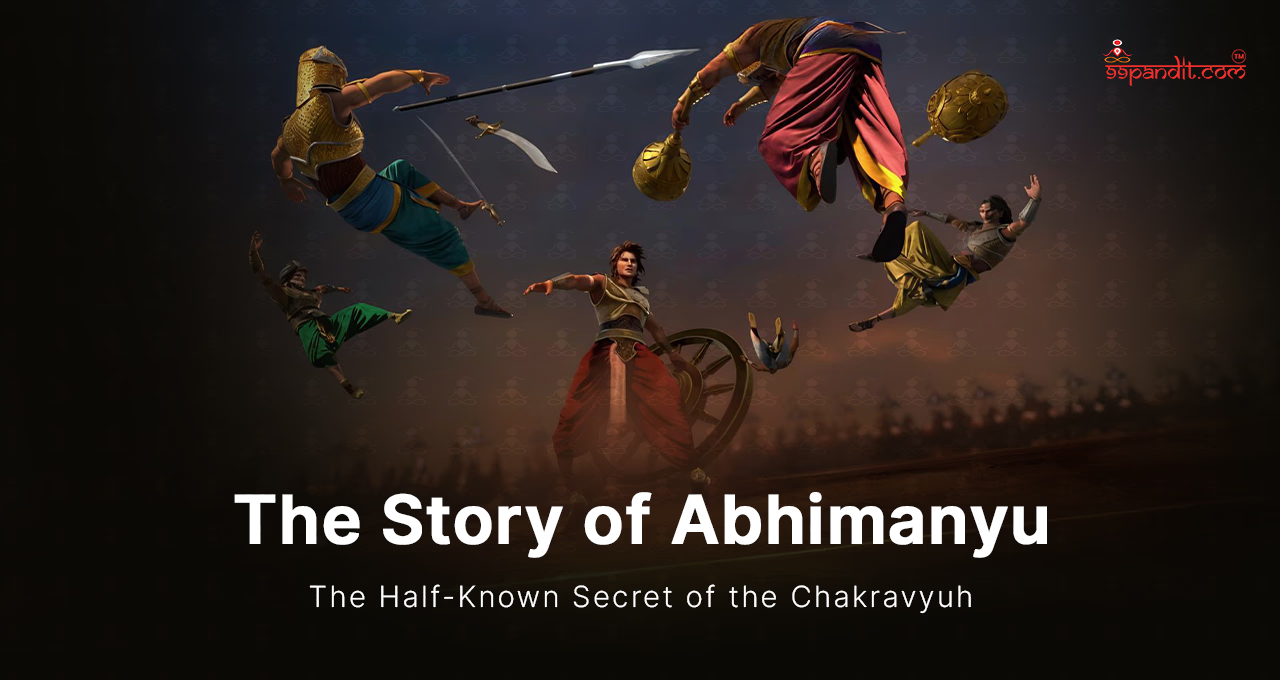
Abhimanyu’s death is not due to his lack of courage or skills. It is mainly due to the unfair warfare practices and breach of moral rules. During the war in Chakravyuh, the core principles of dharma yudha were violated.
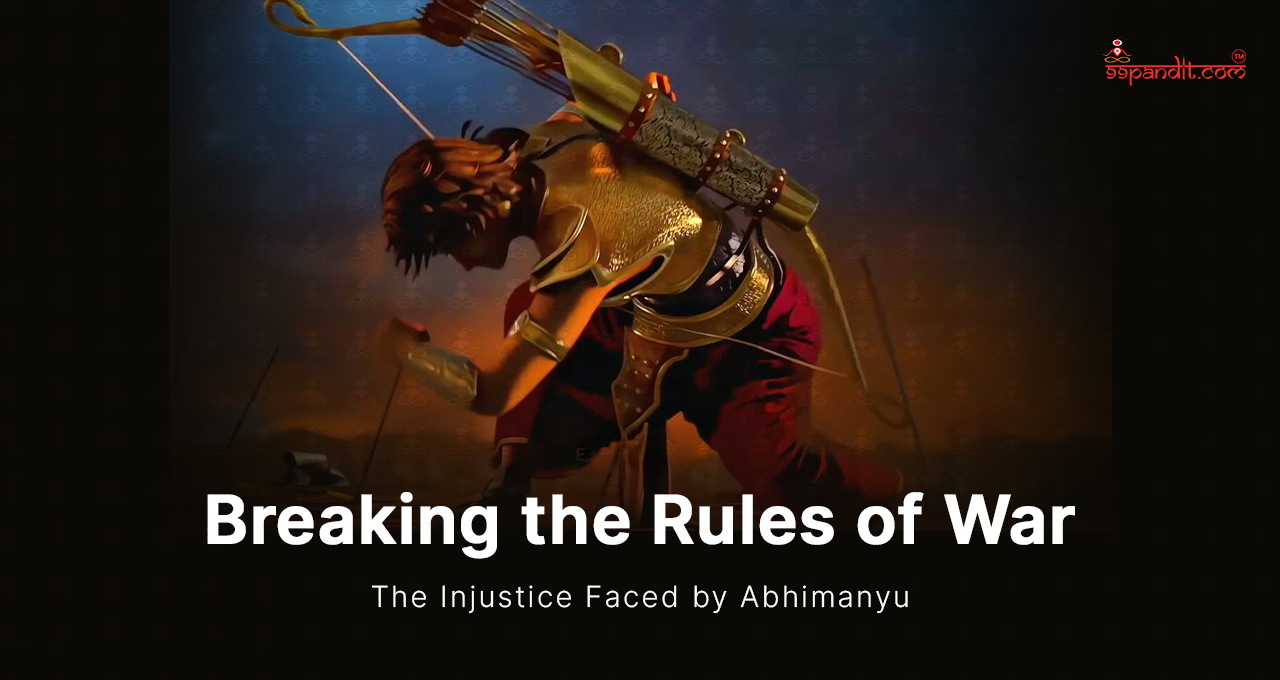
On that day, many sacred rules were broken by the Kauravas and their army, including:
Despite immense bravery and courage, the constant and unethical attacks somewhere broke the fearless warriors of all time.
With his last blow, the life of Abhimanyu comes to an end not as a defeat but as a timeless martyrdom.
His death is not only a loss on the side of the war but also a point that delineates the biggest collapse of morals in the entire history of wars of ancient times.
The decision made brought a sense of guilt and remorse to most of the warriors. Even a teacher like Dronacharya can feel that they have done a wrong thing to the young fighter.
At this time, the battle is no longer a fight for the right but a ruthless conflict. It conveys the lesson that the triumph obtained by giving up dharma will have lasting effects.
Remember that once the honour is lost, it cannot be restored. And the martyrdom of Abhimanyu is a poignant lesson to the fact that not to fight, but to be on the right side, is the one way of being brave, though defeated.
Arjuna’s Grief and Vow:
The unjust murder of Abhimanyu has broken Arjuna. He swore to kill Jayadratha before the next sunset to avenge the death of her son and free herself of that grief.
Teaching and direction of Krishna:
Lord Krishna pacified Arjuna and offered him a cunning way of avenging. Lord Krishna employed his divine powers and caused a fake sunset when he swore to kill Jayadratha before the sun set. It eases the fulfilment of his vow by Arjuna.
Impact on the War:
The sacrifice of Abhimanyu at the most crucial moment has completely transformed the war.
The Pandavas battled with mighty bravery after that death and turned dharma into severe, harsh justice. His death was the turning point in the Kurushetra war.
Even after knowing he might not be able to return, Abhimanyu took a step ahead to fulfil his duty to protect his army.
He tells us that bravery is not only about getting the victory or staying alive, but it is also about sticking to the moral way in difficult times.
Abhimanyu’s incident tells us that sometimes half-knowledge can be risky. Deciding on life without a proper understanding can lead to serious consequences.
Even after being killed, he remains the greatest warrior; following the dharma makes him immortal. The incident teaches that success achieved by going against the value is of no use.
Despite being sixteen, Abhimanyu shows that wisdom, leadership, warrior skills, and bravery go far beyond just an age. His tale proves that moral values and inner strength are more important.
Abhimanyu Chakravyuh’s story is not only the famous episode from the epic Mahabharata. It is a perpetual reflection of the attributes that are rare to find – bravery, honour, and sacrifice.
At such an early age, and being aware of the danger, he made up his mind to go and perform his duty without any fear.
He is an example to future generations because of his heroic boldness and his noble sacrifice. Although he died in the war but his spirit of fighting elevates him beyond any form of success or failure.
He not only attempts to overcome the Chakravyuh, but also demonstrates that power cannot be simply evaluated by simple survival.
The story of Abhimanyu is the best lesson in being determined, righteous, and courageous. His stories continue to motivate many warriors and leaders in the contemporary world.
Besides, the sacrifice of Abhimanyu’s tale in the end narrates that the price of quitting dharma and demonstrates that honour is more effective than weapons.
He reminds us that speaking up about what is right, even when we are alone, leaves some kind of legacy that can never die.
Table Of Content
 Number.

Enter the OTP sent to
Chat with verified astrologers on 99Pandit and receive personalized guidance for every stage of life.


 Ontime Service
 Certified Pandit
 Transparency