Phalguna Purnima 2026: Date, Vrat Katha, Rituals & Significance
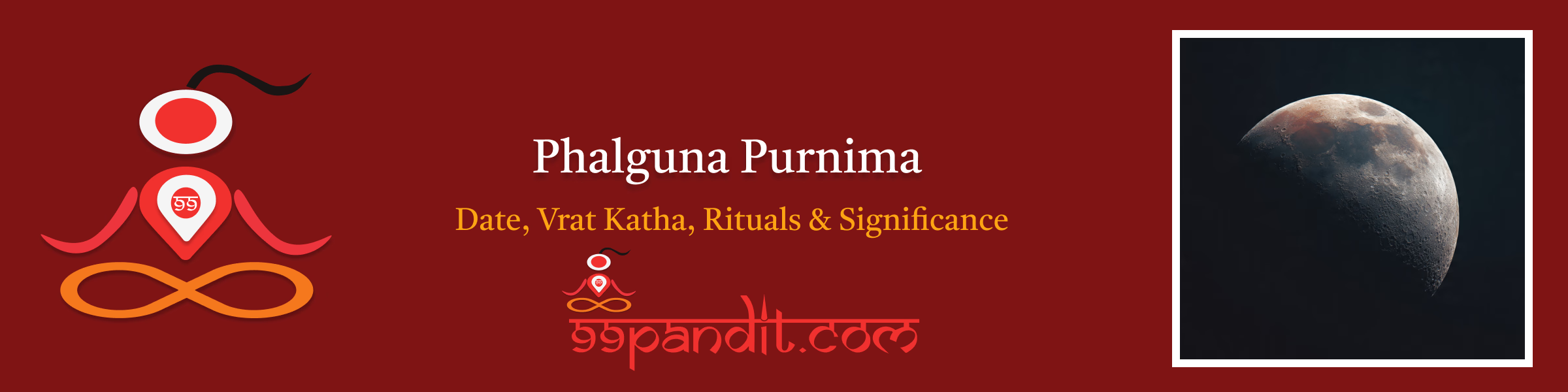
Phalguna Purnima 2026 is the last full moon of the Hindu lunar year. This sacred day will be celebrated on…
 0%
0%
 Book Griha Pravesh Puja Online
Book Now
Book Griha Pravesh Puja Online
Book Now



Last Rites (Antim Sanskar) are the final rituals performed for a departed soul as prescribed in Hindu tradition.
In Hindu culture, every ritual holds deep spiritual and symbolic significance. It is believed that birth and death are inevitable aspects of the life cycle.
This natural cycle cannot be reversed, and performing the final rites is considered essential for the soul’s peace and liberation.
But in every religion, when we die, we leave our human body, requiring proper rituals after death. The Hindu dharma religion is so vast and has its customs and rituals.
Last rites, also referred to as Antyeshti in Hindu dharma, antya kriya, avarohana, and vahni sanskar.

When death has occurred, people do a lot of preparations to be done. In other hours, arranging the puja items and things required to conduct rituals can be a problem and may cause a lot of problems.
Here is when our team’s 99Pandit comes into the picture. We will provide a timely update for the antim sanskar samagri list required to perform funeral rites.
Based on your religion and caste, the list of products can be customised. The team of 99Pandit support and services will always be with you.
Hindu antim sanskar can be said to be a set of Hindu rituals performed for a person who has died. This ritual is performed for the person so that their soul can find peace.
The soul goes to the pitru lokhas without any problem, and their family members get the blessings.
The Hindu Dharma refers to the funeral rites as “Antyeshti” or “the last sacrifice.” “Antim Sanskar” is another name for it.
Hinduism is a large religion, and although different social and economic classes have different funeral customs and rituals, there are certain fundamentally similar activities.
In Hindu dharma, there are 16 samskaras that are followed by the Hindus. Antim sanskar is the last rite that is performed after the person dies.
Whoever takes birth has to leave their body one day, and for that, it is mandatory to perform the last rites to give peace to their soul.
For people, their loved ones spend their whole life happily after the soul leaves the body. For our loved ones who died, it is our responsibility to do all the karmas properly mentioned in the Shastra.
A Hindu pandit is required to perform the antim sanskar ritual and do apara kriya at the house.
Then the body of the dead person is taken to the crematorium, where the pandit performs karya, havan, and pind daan.
Later, the fire was again given to the dead person. You can Book a Pandit Online and find a panditji near me for the Hindu antim sanskar.
The pandit will bring the required puja materials along with him. All the pandits are professionals and well-experienced in performing death rituals.
The Last Rites faith is centred around reincarnation, the belief that when someone dies, the soul is reborn in a different form in the next life.
They hold the view that even after death, the soul lives on and keeps reincarnating until it discovers its real essence.

They attempt to get closer to Brahma, the Hindu God, with each life they live, which may take several.
Additionally, they think that their acts in their previous life—also known as Karma—will affect their soul’s next incarnation.
The concept of Hindu antim sanskar depends on the ancient literature of Hinduism, which describes that the microcosm for all living beings is the reflection of the universe.
It is believed that the Atma or soul is immortal, which means when the person dies, their soul leaves the body and is free from this world. In the next life, the soul is reborn in a new form as per their previous life karma.
We all know that the universe and the human body both consist of five universal elements: earth, water, air, fire, and space.
Hence, this last rite for the person who dies helps the body to return to its five elements.
The ritual is directed towards the way in which the dead person attains moksha. It is the procedure where the soul leads to a new life, leaving behind the already possessed life.
During Hindu antim sanskar, Hindus consider that after death, the physical body is useless and does not require preservation.
They decide to cremate their loved ones because they think it will aid with rebirth and liberate the soul the fastest.
In India, Hindus used to be cremated on the Ganges River, and the family would bring the body there.
Hindus are now cremated locally, and the majority of funeral homes can meet the customs and rites associated with a Hindu cremation.
To perform the procedure of Hindu antim sanskar, we required puja samagri to make it complete.
When the dead person gets mukhagni from his family, you will be required to arrange the following puja samagri items, antim sanskar ka saman:
If the process of agni sanskar is performed on electricity, then the quantity of ghee and camphor will be half of the required amount. At the place where you are doing the funeral process, all the items will be available.

We may require Bamboo, a small pot of mud lying on it, a big and small clay pot, dry cow dung, rope for tying saiyya, and a shroud cloth will be taken separately from the shop.
You must remember that whoever is a family member performing antim sanskar must wear a white dhoti, banyan or white kurta, and pyjamas.
Apart from these, after this ritual, there will be 3 days of worship at home, for the listed material will be required for the next day.
On the third day, separately, two to three materials will be used as instructed by the pandit ji.
Hindu funeral (Hindu Antim Sanskar) procedures traditionally consist of chants or mantras that are presided over by an officiant, who is typically a Hindu priest or the bereaved eldest son. They will assemble the friends and family and guide them through numerous Hindu funeral rites.
These consist of:
The time taken for the last rite of the dead doesn’t last longer than 30 minutes to 1 hour. However, this may depend on the last wish of the deceased and their family.
The “Hindu antim sanskar” is finished one day after someone dies. If the deceased is a man or a widow, the body is wrapped in white fabric, while a married lady (in the process of Suhagan Ka Antim Sanskar) is wrapped in red cloth and accessorised with vermillion to look like a bride.
During “Suhagan ka antim sanskar Hindu customs”, stated that the body should be kept at the house until cremation, which often takes place within 24 hours of the death. Hindu cremations only last a few hours; therefore, embalming is not thought necessary.
It is usual for loved ones to pay a visit to the deceased person’s home to express their condolences.
The tenor and execution of mourning rituals are influenced by the Hindu doctrine of karma. The grieving friends and family spread the virtues of good karma to help their loved ones get ready for a happy rebirth by fostering a favourable environment.
The Hindu antim sanskar for Unmarried women shouldn’t be burned, says Bandhayana. However, some people can decide to conduct formal cremation rites for their female unmarried relatives. Only a bath is permitted during an unmarried woman’s final rituals.
The deceased is given “Vibuthi” or “Chandan” to put on their forehead. Flowers have been placed on the body, a lamp has been set up at the head of the body, and incense is burning in the space.
The body is positioned so that it is sleeping. In general, no food or drink offerings are made. It is forbidden to cremate the body. Single women must be buried. The burial pit is prepared in the “Shamshana” burial cemetery, which is typically situated close to a river or riverbank.
Wealthy individuals could decide to bury their dead in their fields. A Hindu priest or the Karta will preside over the ritual, during which prayers will be said and songs performed.
The family experiences a period of grieving following the death. No cooking will be done in the home until the cremation has taken place as a first indication of respect for the mourning.
Hindu customs state that the house’s fire cannot be ignited until the cremation pyre’s fire has been completely extinguished. Lighting and heating are also prohibited.
It is appropriate to contact or visit the deceased’s relatives as soon as you learn of their passing. Cards, letters, fruits, and groceries might be sent as expressions of sympathy.
Visiting during a funeral is not part of the Hindu tradition. The body of the dead person is kept at the family home until cremation or burial for twenty-four hours.
The grieving family frequently holds a ceremony called “preta-karma” or Hindu antim sanskar on the thirteenth day of mourning, during which they carry out rituals to aid in the soul’s release for reincarnation.
In addition, the family holds a memorial celebration to honour the life of their loved one on the first anniversary of the passing.
Hindus often observe a period of mourning for 10 to 30 days. Families may place a picture of their loved one wearing a floral garland anywhere in their home during this period. Additionally, during this time, guests are welcome.
Funeral rituals, such as last rites, are customary ceremonies that call for the usage of several objects and samagri. These things might be necessary for several funeral rituals, including Chautha/Tehravin, Asthi Visarjan, and others.
The sacred things aid the lost ones in their quest for freedom. The final journey promises to give you high-quality goods and respects the significance of each rite. Funeral planning cannot cut corners.
Our entire crew of 99Pandit has received professional training and is sensitive to your requirements and sentiments.
Visit the website or mobile application of 99Pandit to book Pandit Ji for Bhagwat Katha. Devotees can also book Pandit Ji for pujas such as Rudrabhishek Puja, Griha Pravesh Puja, and Namkaran Puja on 99Pandit. It is easy to book Pandit Ji on 99Pandit.
Antim Sanskar is one of the most important rituals performed in Hinduism. Devotees perform this ritual to seek the blessings of the deities for giving peace to the departed soul. It is considered one of the most essential rituals for the benefit of the departed soul.
This ritual is mainly performed to seek the blessings of the deities to make sure that the departed soul is relieved from the cycle of birth and rebirth.
Devotees worry about performing the rituals of Antim Sanskar as per the authentic vidhi. Not anymore.
They can now book Pandit for Antim Sanskar on 99Pandit. Pandit Ji booked on 99Pandit can easily perform all the rituals of antim sanskar as per the authentic vidhi.
It is easy to book Pandit Ji on 99Pandit. Devotees enjoy booking a pandit for pujas, jaaps, and homams on 99Pandit. Connect with us by dialling: 8005663275 or get in touch with us on WhatsApp.
For more information on Hinduism, such as Puja Muhurat and Dainik Panchang, visit the WhatsApp channel of 99Pandit.
Table Of Content