
Khole Ke Hanuman Ji Temple Jaipur: Timings, History & How to Reach
Surrounded by the scenic hills of the Aravalli Hills, the Khole Ke Hanuman Ji Temple is among the most visited…
 0%
0%
 Book Griha Pravesh Puja Online
Book Now
Book Griha Pravesh Puja Online
Book Now



Ellora is located about 15 miles northwest of Aurangabad. This is popular for its beautiful cave temples in the hills that are about a mile to its east.
These cave temples, which were long covered from view by the engulfing forest, are now among India’s top tourist destinations that few visitors are likely to skip.
This is officially listed on the World Heritage List by UNESCO. The caves are sculpted out of the vertical basalt cliffs of the Sahyadri hills.
This is one of 34 rock-cut structures that are numbered. Buddhist settlement might be found in caves 1 through 12, Brahminical structures 13 through 29, and Jaina caves 30 through 34.
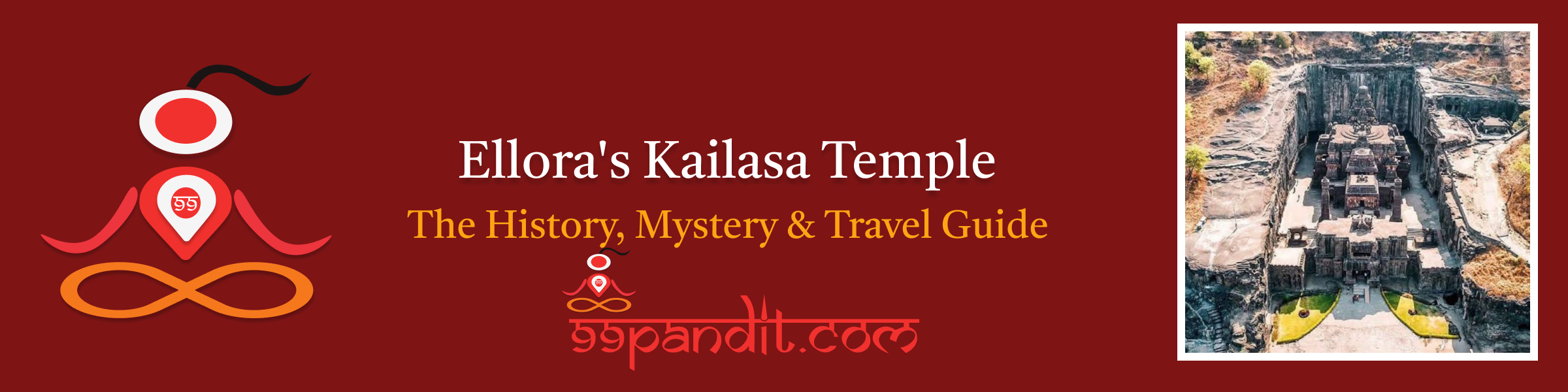
Kailasa temple of Ellora is cave 16, which is one of the largest monolithic structures in the world.
The temple is approximately 300 feet long and 175 feet wide, and it is cut out of a scarp which is over 100 feet high.
In contrast to multiple other ancient rock carvings, the temple premise was made from top to bottom instead of bottom to top.
The work was done with no better tools than a chisel and hammer. Scaffolds were not used at all.
Due to the size of the excavation and the beautiful design, the cave is an unrivalled masterpiece of indian architecture.
The Kailasa temple was built in the 8th century by the Rashtrakuta king Krishna I. As per the descriptions, the temple was meant to copy the mount kailash, the mythical abode of lord shiva.
But it was not only an act of devotion, but a testament of power, representing that the Rashtrakutas can attain something beyond imagination.
Legend has it that the temple was designed after the queen prayed to Lord Shiva for the king’s health.
She promised to develop a temple and vowed to keep fasting until she saw its Shikhara.
To complete the vow, the chief architect planned a unique idea – carving from the top, hence the spire will show first, fulfilling her vow.
Whether the story is true or not, the result remains one of the biggest architectural masterpieces of history.
Read Also: Top 15 Famous Temples in Mumbai: You Must Visit
There is a significant literary proof, some of it false, from medieval times, that refers to the rock temple as Manikeshwar cave temple, as it was made by Queen Manikavati, of the kingdom of Elapura.
The legend says that a specific king of Alajapura was suffering from an incurable illness due to a sin he committed in a past life. The king once travelled to Mahisamala while hunting.
The queen, who travelled along with the king, honoured the god Ghrishnewshwar and made a vow to the lord that if the king recovered, she would make a temple to honor lord shiva.
The king took a bath in the Mahisamala tank and found that he had been cured of the illness after taking a bath.
The queen became happy and asked that the king start the development of the temple right away, so that she could fulfil her vow.
She made the decision to keep a fast until she saw the temple’s shikhara (top of the temple).
The king agreed, but no architect came to complete the temple in a very short time. Kokasa, a local of Paithan in Aurangabad, came to the king and promised him that the queen would be able to see the Shikhara in a week.
Kokasa, along with his team, started cutting the rock temple from the top so that within a week, he could finish carving the top and deliver the royal couple from their plight.
The temple was then named Manikeshwar in honour of the queen, and the king developed a town, Elapura (modern Ellora).
Many historians have studied the temple for decades, and a lot of questions about Kailasa are still unanswered.
The most puzzling is how it was made. Removing more than 200,000 tons of rock with simple accessories looks completely impossible.
A few of the archaeologists believe thousands of workers may have invested their time for decades, even centuries, sculpting the rock.
Others believe there should have been advanced planning techniques far ahead of their time.
There are even legends that attribute the temple’s development to divine intervention.
Locals usually say that only gods can have encouraged or guided this work. Some even say that Steller should have had a hand in this design – an idea covered by the sheer scale and perfection of the design.
Still, these remain mythos; they represent how deeply the temple grabs human imagination. Another mystery is the accuracy of alignment.
The temple design and structure are perfectly balanced and proportioned, something tough to attain even with modern structural tools.
Read Also: Mumba Devi Temple: Timing, History & How to Reach
Like most ancient indian structures, the Kailasa temple comes covered in captivating legends:
As historians concentrate on evidence, these stories keep the temple alive in the hearts of its followers and visitors alike, giving it a spiritual aura apart from stone and design.
When you see the Kailasa temple architecture, you experience as if you are walking into a world where creativity and skills have no restriction.
The temple is not made by gathering stones; instead, it’s sculpted out of a monolithic rock. It makes it one of the most beautiful rock-cut structures in the world.
What makes it more beautiful is that it was cut from top to bottom, as was difficult for any ancient monument then.
When you walk around, you will notice a lot of small and larger informations that describes the amazing skill of builders.
1. Monolithic Structure on a Massive Scale: The complete temple is carved from a single basalt rock, making it one of the biggest monolithic structures in the world.
The method needed planning as if there were just one single chance to make a structure that can be destroyed with one little mistake.
It’s tough to consider how the ancient architects reached the level of accuracy without using any modern tools.
2. Grand Entrance down the Courtyard: When you walk towards seeing the temple, you see a big courtyard enclosed by high walls.
Two large stone elephants and pillars cover it greatly at the front. The carvings on the entrance show scenes from the hindu mythology that give you an amazing look into its ancient art.
3. Pillared Halls and Mandapas: There are many hallways of pillars inside the temple leading to the main sanctum.
All of the pillars are carved with idols of gods, dancers, and holy animals. Moving through it is like moving back, hundreds of years back, into the stunning art of India.
4. Shiva Shrine and the Nandi Mandap: The main sanctum is of Lord Shiva. A large Nandi idol faces the temple, similar to other Shiva temples.
The Kailasa temple interior shrine is beautifully carved and used for rituals and offerings.
5. Graceful Kailasa Temple Height: The Kailasa temple is about 100 feet tall, making it an excellent architectural masterpiece.
Standing under it makes you feel tiny and reminds you of the ancient temples that people have constructed with just simple tools.
Read Also: Kalighat Kali Temple in Kolkata: Timings, History & Legends
For followers, the Kailasa temple is not only an architectural wonder, but a way to show gratitude.
This is a witness as a sacred journey into lord shiva’s world. Mount Kailash is considered to be unreachable for most humans, but the temple was meant to bring that divine existence to earth.
The sanctum with shiva linga inside the temple feels calm and powerful. The moment you enter, the outside world looks distant.
The travellers believe that offering prayer here is as holy as praying directly at Mount Kailash in Tibet.
However, among the long list of Kailasa temple’s history and the facts is the effort to ruin it.
In the year 1682, Mughal king Aurangzeb, who demolished thousands of temples, sent his 1000 people to destroy the temple.
Also, after working nonstop for 3 years, they could not destroy the temple. They only managed to impair the statue.
Finally, Aurangzeb, more likely to fear the divinity of the temple, gave up destroying the temple.
Read Also: Shri Radhavallabh Lal Ji Temple, Vrindavan: Timings & History
Before you plan for your travel to the Kailasa temple, there are some basic details that help one to know the place.
It will make your trip smoother and also more enjoyable.
It is better to know which month or season is pleasant to visit Ellora’s Kailasa temple.
Selecting the right time lets you enjoy the architectural, peaceful surroundings, great views, and not get too hot or tired while visiting.
Read Also: Ram Temple in Ayodhya: History, Significance & Budget
Reaching the Kailasa temple is as simple as it is one of the most famous heritage spots in Maharashtra.
Whether it is via plane, train, bus, or also the car, the roads to reach Ellora will be quite effortless. The guide will help you plan your trip without being confused.
Multiple rock-cut temples are present in India, but the Kailasa temple is unique among them:
If compared to wonders such as pyramids of Egypt or Machu Picchu in Peru, the Kailasa temple stands tall as India’s reply to the question: ‘What can human manage achieve without tools?’
Read Also: Sri Kanchi Kamakshi Amman Temple: Timings, History & Secrets
If you are thinking to visit Kailasa temple, there are so many other attractions nearby that make your journey more rewarding.
1. Ajanta Caves: Established around 100 km from Ellora, known for their beautiful Buddhist paintings and sculptures.
2. Grishneshwar Temple: It’s only about a short walk from Ellora, one of the 12 sacred jyotirlinga of lord shiva. A visit here amazingly complements your Kailasa experience.
3. Daulatabad Fort: The medieval fort was once the capital of the Delhi Sultanate under Muhammad bin Tughlaq. Its unique mechanism and amazing view make it a good stop.
4. Aurangabad City: The crowded city close to the temple has its own gems – Bibi ka Maqbara, usually known as ‘Mini taaj mahal’, and a crowded market selling handloom and handicrafts.
5. Lonar Crater Lake: You can travel here to experience something unusual, made from a meteor impact. This is one of the saltwater lakes construct the way, covered by myths and temples.
The Kailasa Temple is not only a monument, but it also gives you an experience that you will never forget.
Standing in front of the temple that was made out of one stone makes you feel like you were sent back in time when art, faith, and skill were at the top of their highest level.
Hence, it makes it one of the best visiting places in Maharashtra. Its mystery, calm environment, along with beautiful carvings, make it a spot that every pilgrim must see at least once.
Whether you travel here because of history, photos, spirituality, or curiosity, you’re sure to leave with memories like no other has.
Table Of Content