Shila Devi Temple, Jaipur: Darshan Timings, History & How to Reach
Shila Devi Temple, Jaipur, is the house of the famous idol of Goddess Durga located in Amber Fort. There is…
 0%
0%
 Book Griha Pravesh Puja Online
Book Now
Book Griha Pravesh Puja Online
Book Now

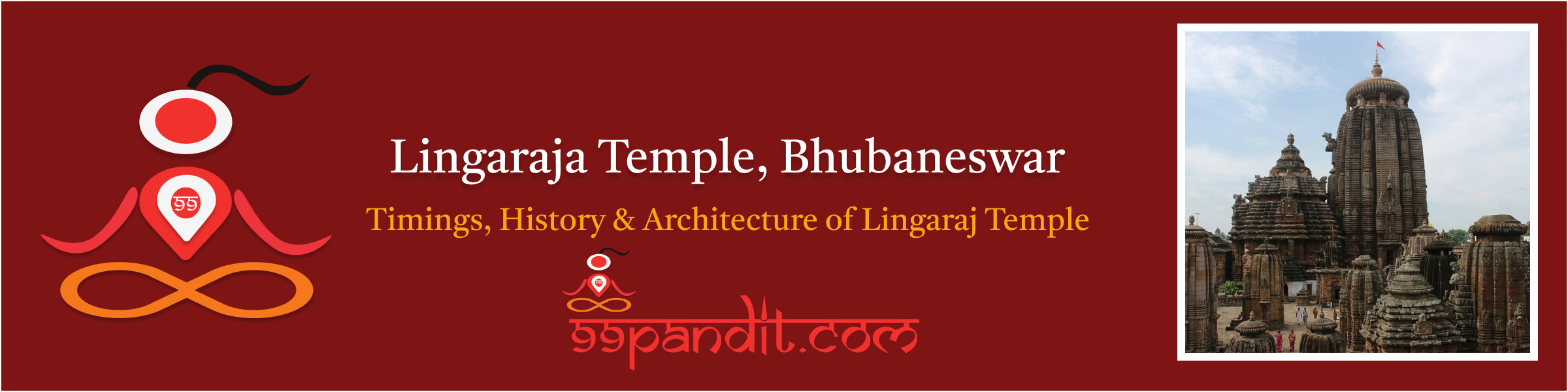


Located in the spiritual heart of Bhubneshwar, the capital of Odisha, Lingaraja Temple is one of the oldest and most revered temples dedicated to Lord Shiva.
Its architectural marvel, considered to be over 1,000 years old, is not just a temple but also a living legacy of India’s sacred spiritual and cultural customs.
It draws lakhs of pilgrims and travellers every year. The temple is known as a glorious key place to Odisha’s Kalinga architecture, heritage, and devotion.
Let’s know more about its spirituality through the grand sanctum.
Are you coming to Bhubneshwar to visit Lingaraja temple? Then, you must read this section to know the timing and the best time to visit the temple.
Planning for the lord shiva temple needs a bit of timing to complete immersion in the spiritual energy of the 11th-century marvel.
While you’re coming for a quick darshan or to experience the ancient culture, here are all the details you need to know for your trip.
The temple has a strict traditional routine, which is open early for rituals and closes in the afternoon for the rest of the day.
To witness the complete spiritual glory, try to visit these daily and seasonal rituals:
Morning aarti (Mangala Aarti):
Performs from around 5:00 AM to 6:00 AM. It’s one of the most auspicious times. The recitation and lamp lighting give a meditative environment before the daytime ritual.
The Mahadipa (The great lamp):
If visiting during Maha Shivratri, you can see the breathtaking mahadipa ritual. It occurs around 10:00 PM, a huge lamp is brought to the very top of the 180-foot spire.
Many devotees wait in silence for the light to appear before completing their day-long fast.
The Suitable Season:
October to March are the months that are best to visit Bhubaneswar. The weather is positively hot (15 degrees Celsius to 25 degrees Celsius), and one can walk around the temple without shoes in the stone courtyard.
The Golden Hour:
You will not only escape the heat of Odisha, but you will also see the Sahana Mela, where the worshippers can have a better look at the deity.
Pro Tip: In case you are a photography fanatic, you should visit the Curzon Viewing Platform right outside the north wall during the Blue Hour (immediately after sunset).
The temple is also well lit, and there are no crowds, which facilitates maximum shots of the large Vimana.
Here is a quick summary about Lingaraja temple, which is nestled in Odisha’s capital, Bhubneshwar.
| Temple Name | Lingaraj or Lingaraja Temple |
| Location | Bhubaneswar, Odisha, India |
| Primary Deity | Lord Shiva (Harihara – combined form of Shiva & Vishnu) |
| Founded By | Somavamshi Dynasty (Major contribution by King Yayati II) |
| Established | 11th Century CE (parts over 1,000 years old) |
| Architecture Style | Kalinga style (Rekha Deula, Pidha Deula, Khakhara Deula) |
| Main Tower Height | ~180 feet |
| Temple Timings | 6:00 AM – 9:00 PM |
| Major Festivals | Maha Shivaratri, Ashokashtami Rath Yatra, Kartik Purnima, Makar Sankranti |
| Entry for Non-Hindus | Not allowed inside sanctum (can view from platform outside) |
| Nearest Airport | Biju Patnaik International Airport (~4.5 km) |
| Nearest Railway Station | Bhubaneswar Railway Station (~4 km) |
| Nearby Attractions | Bindu Sagar, Mukteswar Temple, Rajarani Temple, Khandagiri & Udayagiri Caves |
| Nearby Restaurants | Dalma, Hare Krishna, Swosti Premium, Truptee, Hotel Priya |
| Nearby Hotels | Mayfair Lagoon, Swosti Premium, Hotel Excellency, Kalinga Ashok |
Lingaraja temple has very great religious significance for both Shaivites (followers of lord shiva) and Vaishnavites (followers of Vishnu).
It is mainly dedicated to lord shiva in the form of Harihara (a combination of Shiva and Vishnu).
The temple has a unique fusion of Shiva and Vaishnavan customs that shows Odisha’s inclusive spiritual culture.
It is considered that the main deity, called Harihara linga, is Swayambhu – self-originated.
The temple gets its description in ancient scriptures such as the Brahma Purana and was developed during the rule of the Somavamshi dynasty, with primary reconstructions done in the 11th century CE under the king Yayati II.
Moving with the complex of Lingaraja temple is like stepping into a frozen symphony of sandstone.
It shows the accurate pinnacle of Kalinga architecture; the 11th-century design isn’t only a building, but a mathematical and artistic marvel, which is a testament to the time for nearly a millennium.
The temple’s design follows a linear axis, aiding the devotees from the physical world into the spiritual heart of the moment.
All halls give distinct goals, being more detailed as you move inward.
The best wow-inducing element is surely the Shikhara (the main spire). It is about 55 meters (180 feet) tall, and it towers over Bhubaneswar. The real piece of art here is its Curvilinear Spire.
These spires are incurved at the top, with a huge Amalaka (a stone disk shockingly like a sun-fruit) and a Kalasa crowning the top, unlike the straight-edged pyramids of the South. This is a vertical pull, meant to attract the eye and the spirit, up to the heavens.
The architects of the Somavamsi dynasty were experts in geology. They used two primary materials:
Looking closely at the exterior walls, you will find not a single inch of stone untidied. Since the miniature temples replicating the very temple itself cut into the facade are the exceptions to the rule, the Lingaraja Temple is, in fact, a stone bible of the Hindu mythology.
The Lingaraja temple’s history is not only a date mentioned on a map, but a thousand-year-old evolution.
This is a small breakdown of how the shrine in the mango forest became the ‘Crown Jewel of Odisha.’
Why is Bhubneshwar known as the Temple City? It all begins with just a single tree.
| The Legend (Mythology) | The Legacy (History) |
| The Holy Tree: Shiva decided to reside beneath a single Mango tree (Ekamra) to get calm from the crowds of Varanasi. | The Royal Choice: The place was strategically desired near the Bindu Sagar Lake to act as the spiritual centre of the Somavamsi Empire. |
| The Demon Slayers: Goddess Parvati conquered the demons Kitti and Vasa here. To satisfy her thirst, Shiva made the Bindu Sagar. | The Engineering: The Bindu Sagar was a huge human-made reservoir created to deliver water for rituals and signify the union of all holy rivers. |
The most amazing historical pivot happened when the Ganga kings came. They did not ruin the temple; they blended it.
The Lingaraja temple has suffered many waves of invasions that ruined multiple Indian temples. Its history is a key testament to Kalinga Architectural resilience.
As it was developed with interlocking sandstone blocks without any mortar, it has seen earthquakes and centuries of monsoon rains, known as a ‘living’ history book of 11th-century India.
1. Maha Shivaratri:
See the 180-foot temple spire lit under the light of thousands of earthen lamps. The climax of the temple happens at midnight with the Mahadipa.
A number of pandits climb the largest Shikhara to light a big lamp at the very top. Only this light could be visible to devotees to break their day-long Shivratri fast.
2. Ashokashtami (Rukuna Rath Yatra):
As Puri is popular for its chariot festival, Bhubaneswar has its own huge version. Lord Lingaraja travels to the Rameshwar temple in a big, colourful wooden chariot.
The chariot is popularly called Analeuta; unlike most rath yatras, it is not turned around on the return journey, the horses and altar are just shifted to the other side, and it is pulled backwards.
3. Chandan Yatra:
Organized at the sacred Bindu sagar lake, the celebration is about ‘cooling’ the lord. The idol of lord lingaraja for 21 days is taken on beautifully designed boats for a cruise around the lake.
The air is thick with the fragrance of sandalwood paste, and traditional Odissi music resonates around the water.
The Lingaraj Temple is situated in one of the most favourable areas in Bhubaneswar, and therefore, it can be easily accessed from the airport, railway station, bus station, and other areas within the city.
It is very easy to commute to the temple since auto rickshaws, local buses, and private taxis are easily accessible in the city.
Lingaraj Temple and Biju Patnaik International Airport are about 4.4 km apart, and 10 minutes by auto rickshaw or taxi can be enough to get to the temple.
The railway station of Bhubaneswar is approximately 4.8 km and can be reached very easily in about 12 minutes by availing an auto rickshaw or taxi service.
Local buses or a personal cab, which has to be hired by the leading car rental companies in Bhubaneswar, will also enable tourists to get to the shrine.
The Lingaraya Temple is not merely a masterpiece of the Kalinga architecture or even an 11th-century relic, but a living monument.
As compared to most ancient structures, Lingaraja is the throbbing spiritual core of Bhubaneswar.
The rhythmic chanting of the morning Aarti, the gravity-defying climb of the Mahadipa in the Shivaratri, all the rituals that are going on now are the direct reflection of the rituals that were initiated a thousand years ago.
It is one of the extollations of how India managed to keep its soul as the world around it evolves.
It is not so much the stone spire 180 feet in the air that attracts you to this place, as the strange harmony of its Harihara god, but a visit here is a journey into Odishan tradition itself.
Let’s Connect! Have you ever seen the grandeur of the Kalinga style of architecture physically? If not, then plan your trip now and experience divine presence!
Table Of Content
 Number.

Enter the OTP sent to
Chat with verified astrologers on 99Pandit and receive personalized guidance for every stage of life.


 Ontime Service
 Certified Pandit
 Transparency