Moti Dungri Temple Jaipur: Timings, History & How to Reach
Moti dungri temple known as a revered spiritual landmark in Jaipur, Rajasthan. The temple is dedicated to Lord Ganesha, the…
 0%
0%
 Book Griha Pravesh Puja Online
Book Now
Book Griha Pravesh Puja Online
Book Now

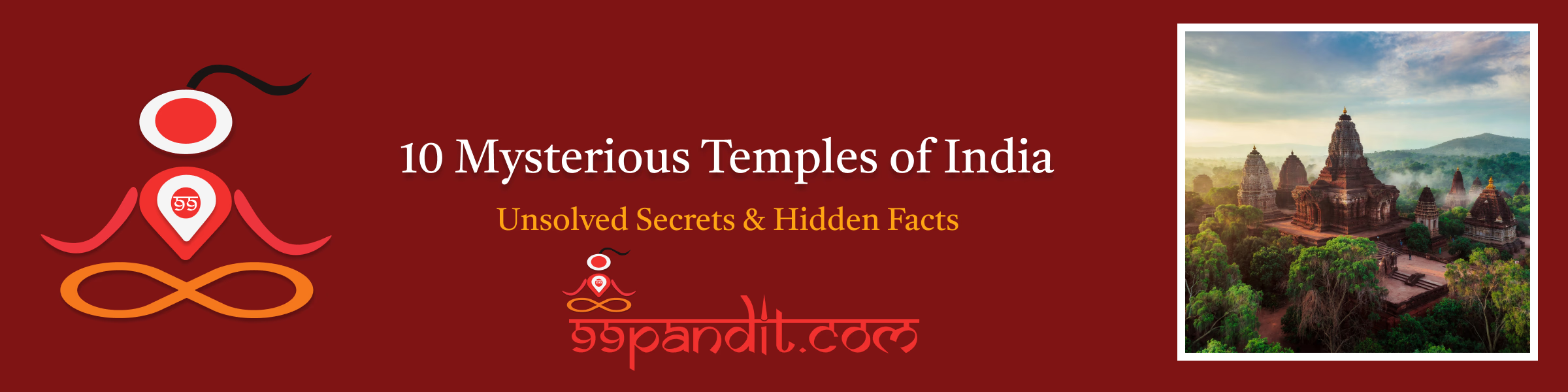


Mysterious Temples of India: India, a place where ancient traditions and spirituality are home to countless temples that not just offer a place of honouring but also share the mysteries that defy the very combination of science and logic.
Dispersed around the country, these mysterious temples of India beckon exciting minds to discover the enigmatic stories and undiscovered secrets.
These temples are not just ordinary temples – but a gateway to the place where miracles happen regularly and sacred stories still tell their secrets.
Whether it’s the temples where flames burn without fuel eternally, pillars seem to float in mid-air, and shadows secretly disappear at noon.
Every stone has a story that challenges what we think is possible or not; its architecture makes us think about what we know about ancient abilities.
If you’re a mystery seeker or a believer drawn to divine histories, the list of these temples will leave you awed.
Join us on a way through the heart of India’s mysterious temples, where mystical and logical thoughts leave us amazed by the inexplicable.
There is a list of eccentric temples of India that might excite you. Take a look to know how many you have heard about the most secret-keeping temples in India.
The Kamakhaya Devi Temple, located in Guwahati, Assam, is slightly different; it has no statues to worship.
Every monsoon, something mysterious happens – the goddess apparently menstruates.
This is quite unusual, but people celebrate the period. This is the place where Sati’s dismembered body parts have fallen. It opens every day from 5:30 am to 10:30 pm.
It is essential to visit the Kamakhaya Devi Temple for newlywed couples. Instead of a regular idol, you will see a stone shape showing a part of the female body known as ‘Yoni’. Followers cover it with a red saree.
The most surprising thing is that the temple is located on a hill next to the Brahmaputra River, which turns blood red for three days in every monsoon (June).
The people celebrate it as a festival called Ambubachi for three days. It’s strange how the people celebrate menstruation and womanhood, disregarding the general stories of temples.
There is no entry fee for regular people. But if you’re from a parliamentary or defence team, you may have to pay a small cost.
There’s also an option for a special entry if you want to experience something unique.
When was it built: 8th-9th century
Who built it: The king of Koch, Naranarayan, redeveloped a specific part of the original temple during 1555-1565, which was again destroyed by kalapahar in 1572.
And finally, at the time of the reign of the Ahom dynasty, the temple again underwent a massive renovation.
Sree Padmanabhswamy temple is situated in the core of Thiruvanathapuram, Kerala. The auspicious place has some rules – that only Hindu people can enter the temple.
To maintain temple purity, worshippers from other religions are not allowed. The temple has an idol of Lord Padmanabhaya, a form of Vishnu.
The devotees believe that seeking the darshan at this temple fulfills their wishes. It’s an ancient temple dating back to the 8th century CE, and the Chera style of structure motivates its design.
Before you visit the temple, follow the strict dress code. Men should wear a dhoti, and women must wear a saree. No Western clothes are allowed.
Temple has been handled by the Royal family of Travancore. Carrying out electronic devices is not allowed.
The vaults are cursed, but one thing is sure. No scientist can explain the weird things that happened to those who died suddenly when they tried to open the vault.
Like other stories of cursed treasures, this too remains one of the mysteries of Indian temples.
When was it built: 8th century
Who built it: The structure of this was reconstructed by Maharaja Marthananda Varma in 1731.
It’s one of the most timeless and wealthy Hindu temples in South India. The mystery here among the people of Kerala is that there are six underground vaults in the temple that can’t be accessed by the general public.
Consider a temple where you experience loud screams and see some strange things; that is Mehandipur Balaji in Rajasthan. It’s not an ordinary temple – quite mysterious.
In this temple, pandits conduct something which is known as exorcism, which is shown in movies to help people who are suffering the evil effects of negative spirits.
The temple is dedicated to lord hanuman, who is worshipped to remove troubles.
Timing of temple starts every day from 7:30 am to 11:30 am and from 12:00 pm to 8:30 pm. But on Tuesday, a special aarti is performed in the evening dedicated to lord hanuman.
Followers visit here, wishing to recover their family or friends from evil things or black magic. But be careful, it could be disturbing.
You will see people hanging, pouring hot water on themselves, or being tied by the priest. This is very unusual compared to other temple visits.
What is to remember about this temple that you’re advised not to look back while leaving the temple, or eat anything if someone offers you food?
No photos or strictly touching anything? Don’t want to invite a demon into your body, do you? No, just visit, pray, and come back.
When was it built: Early 11th century
Who built it: A devotee named Sri Ganesh Puri Ji
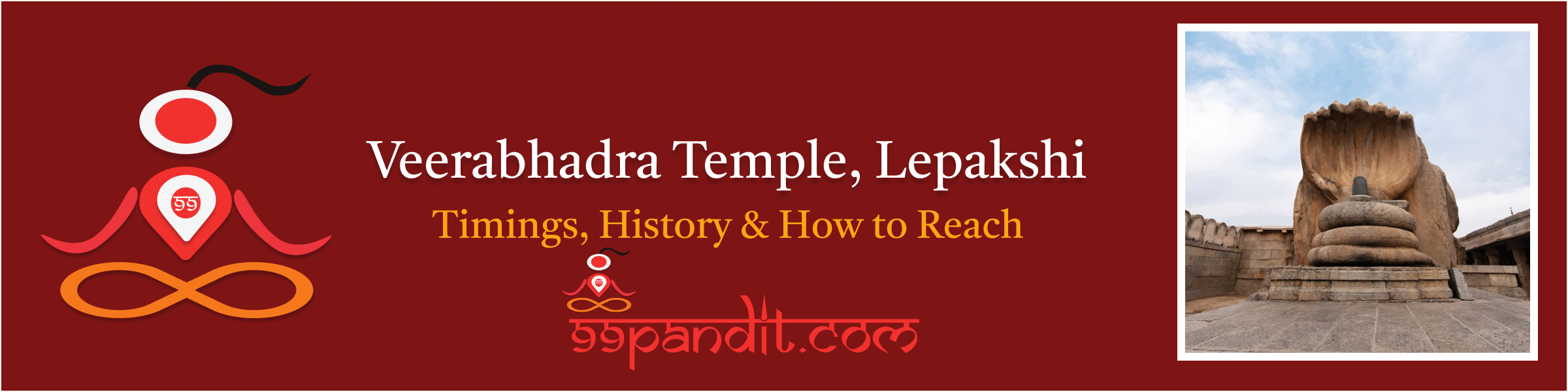
So, the next mysterious temple is the Veerabhadra temple found in the Lepakshi district of Andhra Pradesh.
This is mysterious due to something strange – out of 70 big pillars, one pillar doesn’t touch the ground, disregarding gravity.
That hanging pillar is something to witness for multiple visitors.
Dated back to the 16th century, it is dedicated to lord Kaal Bhairav Nath, a form of lord shiva.
You can visit the place any day of the week from 5 am to 8:30 pm. This pillar is not only for show; you can also keep a cloth under it to know the space between the pillar and the ground.
When you visit the temple, explore the ancient structure, marvel at the amazing carvings of gods and goddesses on the walls and pillars.
A mysterious place where history and science come together.
Contributing to the wonder, a massive footprint was implanted in the temple’s stone floor, considered to belong to Goddess Sita.
This is why it is perpetually moist, with water seeping into it constantly. Such a thing adds another layer of mystery to temples across India.
When was it built: 16th century
Who built it: Two believer brothers, Virupanna and Viranna, who were governors under the Vijayanagara Empire
A temple dedicated to Lord Kaal Bhairav, one of the mysterious temples in India. He is the reincarnation of lord shiva.
Temple opens from 5:30 am to 1:30 pm and 3:30 pm to 10:00 pm. The mystery of this temple is – apart from traditional offerings, people offer wine or whiskey to the lord.
You will not find a regular or a sweet shop here. People buy these things from outside the temple before entering.
Seek blessings, courage, and happiness from lord kaalbhairav. You may wait in long queues, but it’s worth it, mainly during special occasions.
The crowd’s magical enthusiasm gives a unique experience of such a mysterious temple located in Varanasi.
The most strange thing is that the pandit takes out a small plate and pours some amount of wine and attaches it to the mouth of the idol.
And miracle! The alcohol disappears. It’s one of the unsolved mysteries in an indian temple.
When was it built? It dates back over 6000 years, but was built in the 18th century.
Who built it: It’s considered to have been initially built by King Bhadrasen. The Maratha rulers made the architectural paramount of the present temple structure.
A mystical Venkateshwara temple in the Tirupati region of Andhra Pradesh. Almost 50,000 pilgrims visit the temple to seek the blessings of lord venkateshwara, who is called Balaji or Vishnu.
Its unique entry procedure makes the temple mysterious. Submit a declaration form to enter to show your faith in the lord.
This is so fascinating that international pilgrims are attracted to the place. The deity inside the temple is known to wear real hair and is known to sweat.
Surprisingly, the back of the idol also gets wet when the pandit keeps trying to dry it.
It’s not only spiritually rich but also one of the wealthiest temples, with an annual turnover of approximately 6.5 million USD.
It does not depend on any donation and is popular for the Tirupati festival.
Followers show their devotion by donating their hair, and many of the brave ones, both male and female, shave their heads.
If you seek special entry, there’s a VIP option that costs 300INR. Disabled people can have a special darshan from 10 am to 3 pm.
When was it built: Dated back 2000 years old during the 9th to 10th centuries under Pallava, Chola, and Pandya dynasties.
Who built it: The Temple was established by Tamil kings, Vijayanagara rulers, especially King Krishnadevaraya, who developed the temple.
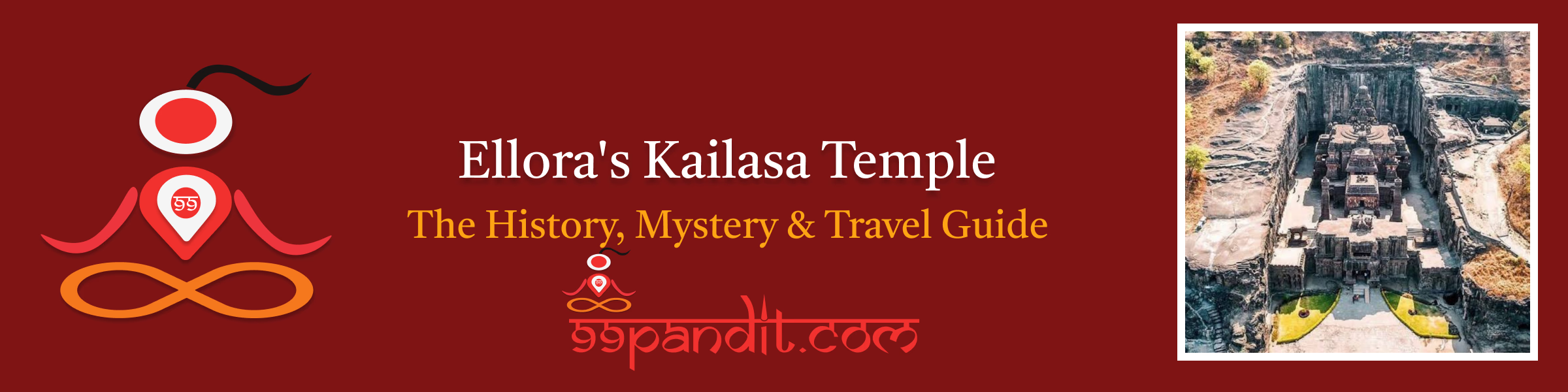
Kailasa temple in Ellora caves, Maharashtra, is special due to its not being built, but created from a single rock.
Consider the whole temple developed from a mountain with so much detailed crafting.
This is the biggest rock-cut Hindu temple in the 16th-century Ellora Caves. Followers develop the temple for lord shiva.
You can seek darshan anytime from 6:00 am to 12:00 pm and 5:30 pm to 8:00 pm.
This is like no other, made on a single rock; inside, some carvings share stories from the Ramayana.
A long time ago, Mughal king Aurangzeb came to destroy the caves, but unexpectedly, nothing happened to the temple.
As per Archaeologics, it will still take time to figure out around 30 million carvings in Sanskrit.
Few people say it’s mysterious because no one today has the ability to make something detailed.
What’s a fantastic fact about it? It took 18 years to be developed. The legend Lord Shiva offered the queen who built the temple a weapon that could convert stone into vapor.
This place is constructed using the same weapon that now lies beneath, and no one can get there.
Another provoking mystery is that some people consider that the Kailasa temple was created by aliens.
When was it built: 8th century
Who built it: Rashtrakuta King Krishna I
The wonder of the Stambheshwar Mahadev temple near Vadodara in Gujarat, which appears and disappears with the tides.
This is one of the temples dedicated to lord shiva and has unique timings from 6:30 am to 10:00 pm.
It’s right between Arabian seashores and the bay of Cambay, which is a very special thing about it.
When high tides come, the waves cover the temple, and you can’t see it. But when these are low, it magically becomes visible. A unique experience that represents the beauty of nature.
When was it built: Built 150 years ago, as the Shiva linga there is said to be over 1000 years old.
Who built it: After killing the demon Tarakasur, Lord Katikeya established the Shiva idol to satisfy his guilt, according to Hindu mythology.
But the current architecture was built under the reign of Sadashivrao Bhau, the Commander-in-Chief of the Maratha army.
The Jwalamukhi temple in Himachal Pradesh has been one of the most mysterious temples with unexplainable events.
This is intriguing, how no idol has ever founded in a temple, but there are flames constantly burning from the ground.
There is a total of nine flames showing the navadurgas, and the source of the fires is still unknown.
Even you can’t ruin the fire, and it’s been burning since the temple was built. There is one more story about the temple.
Dated back during the reign of Akbar, the great, he came to the temple to verify its authenticity after hearing about the myth.
He kept trying many times to smash the flames with a stream of water, but to his surprise, the flames remained to burn, upheld by the immense power of the goddess. This is no doubt one unsolved mystery of indian temples.
When was it built: 19th century
Who built it: Raja Bhumi Chand of the Katoch dynasty founded the temple after visualizing its location in a dream.
In the 19th century, Maharaja Ranjit Singh initiated renovation duties and gold-plated the temple dome.
The last is the Om Banna temple. If you ever get yourself on the Jodhpur-Pali expressway, ensure to visit this.
You would have seen people offering idols, stones, and animals. But here they honour a Royal Enfield Bullet 350.
The status of the vehicle is known as ‘bullet baba shrine’ and is often visited by people after buying a new bike.
So, the story of this place dates back to 1988. The specific bullet belonged to the local village leader, who was Om Banna, met with an accident.
The local police took the bike with them, but the next day it went back to the accident spot, where the villagers had made the temple.
The faith is that Om Banna’s spirit keeps the travelers protected.
When was it built: 1988
Who built it: Locals of Chotila village in the Pali district of Rajasthan
India, recognized for its immersive culture and rich customs, is home to countless temples, each with its own unique story.
While most of the sacred places follow conventional rituals, a collection of extraordinary temples disregards norms and adopts the extraordinary.
With several temples in India, these mysterious temples are known as beacons of faith, curiosity, and wonder.
The list is not complete, and there are so many mysteries awaiting our exploration.
So, dear explorers, keep your spirit high and excite yourself as we continue our quest to unravel the secrets of India’s ancient gems.
Whether to dive into the tides, presenting spirits instead of flowers, these places signal us to look beyond the ordinary and contemplate the profound secrets at the convergence of spirituality and the unexplained.
Table Of Content
 Number.

Enter the OTP sent to
Chat with verified astrologers on 99Pandit and receive personalized guidance for every stage of life.

 Ontime Service
 Certified Pandit
 Transparency