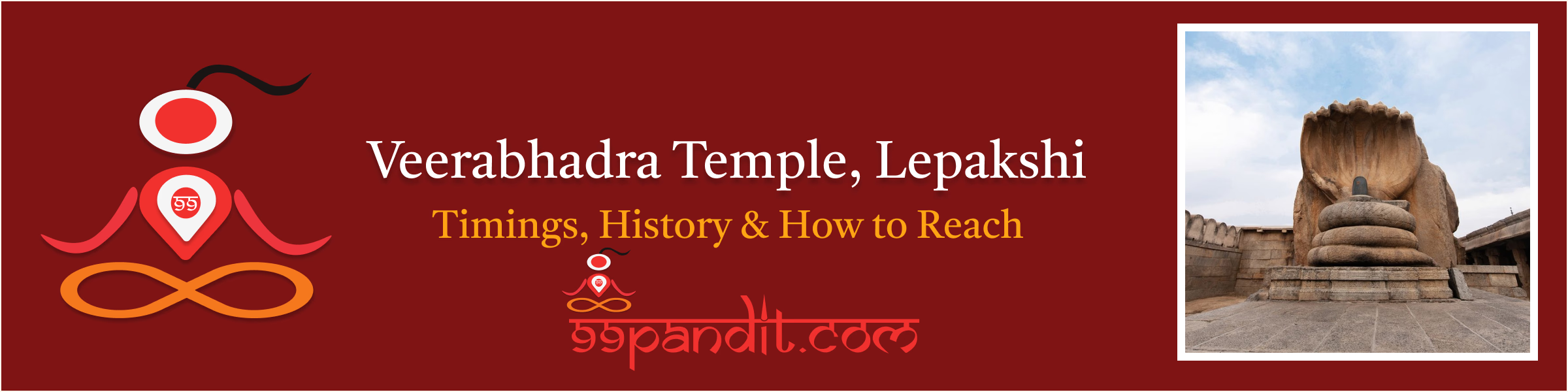
Veerabhadra Temple, Lepakshi: Timings, History & How to Reach
Veerabhadra temple, also called Lepakshi temple, was made in the 16th century by two brothers, Viranna and Virupanna. They were…
 0%
0%
 Book Griha Pravesh Puja Online
Book Now
Book Griha Pravesh Puja Online
Book Now

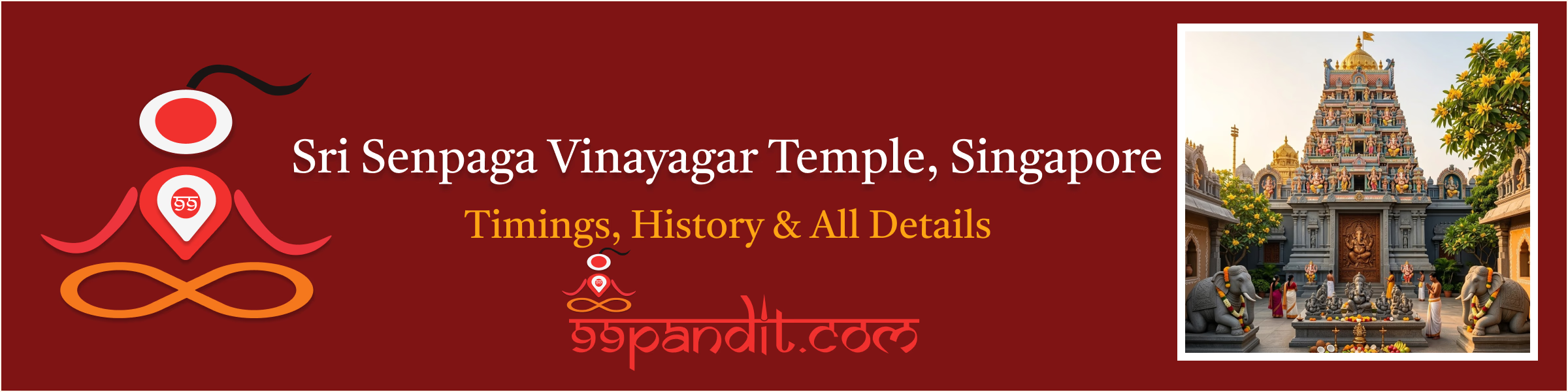


The Sri Senpaga Vinayagar temple in Singapore is very special for devotees who follow the Hindu religion, which is dedicated to the elephant-headed god, Lord Ganesha.
The temple is located on Ceylon Road and has a history that dates back to the mid-19th century, begun by Tamil people from Sri Lanka.
The temple became more popular on February 7, 2003, when it was identified as a historic site.
Now, not only people who go there to pray, but even tourists who want to explore something unique visit the temple. This is a place full of history and loved by multiple people who come to visit it.
There is more to this; read the complete article to know the temple timing, history, and all details.
The Sri Senpaga Vinayagar temple is located at Ceylon Road in Singapore, which is a 150-year-old Hindu temple.
The temple is popular for four granite structures showing lord ganesha in 32 postures.
This was one of the most successful works of 20 Indian artisans who invested 20 years in this masterpiece.
The temple was made in 1850 when the idol of Lord Vinayagar was found after it washed up on the banks of a stream near a Champak tree.
The tree stands on the bank of the pond and serves as an identifying part of the Senpaga temple.
The temple was developed by Mr. Ethirnayagam Pillai, who was a Ceylon Tamil who made the first structure with the help of indian workers.
It was a decent cover with an attap roof. The beautiful abode with the Champak tree became the place of Sri Senpaga Vinayagar.
The temple became a historic site in 2003. The Vinayagar shrine is from the time of the earliest groups of Sri lankan tamil emigrates in Singapore.
Read Also: Baba Baidyanath Temple: Timings, Pooja, And History
If you are thinking of visiting the Sri Senpaga Vinayagar temple, you will find out the traditional split-schedule typical of Hindu temples in Singapore.
The temple is accessible every day during the following times:
Another crucial point in the religious life of the Ceylonese Tamil diaspora in Singapore is the establishment of Sri Senpaga Vinayagar Temple in the 1850s.
Also, the accidental finding of a Vinayagar murti by sea captain Ethirnayagam Pillay in the area around a prosperous chenbagam tree in Ceylon Road was not just a coincidence but a miracle of a people who needed a spiritual place to hold on to in the new land.
After this foundational event, devotees erected a simple shrine, which soon became the spiritual center of the newly settled Ceylonese Saivite community.
It became an essential cultural point of reference. They could hold on to their unique religious identity and practices in the midst of colonial Singapore, being so much more complex than what came before.
This has heralded a long-standing institutional presence. The history of the gradual development and constant renewal of the Ceylonese Tamil community can be traced through the history of the building.
Starting as a simple shrine in 1900 and developing into a strong brick temple in 1915, and then rebuilt in 1930, 1960, and 1986.
The gradual growth in construction and the growth of the great Golden Rajagopuram and other buildings in the 2001-2003 renovation.
It was not only a testament to the increasing patronage of the Saivite institutions, but also their deep sense of duty to conserve and nurture their own ancestral legacy.
The temple is therefore a historical relic of the faith of the community, the ability to become collectively active, and their ability to leave a vivid cultural and religious heritage. It is deeply ingrained in the identity of Singaporean society.
Discovered in the 1850s under the sea, redesigned in 1915 and 1930, expanded in 1960 and 1986, important developments in 2001 – 2003 took place to deliver the golden Rajagopuram.
Elaborate conservation in 2016-2017 changed the design of the sanctum. Its cultural facilities and mechanical systems, while showing a heritage gallery describing the SCTA.
The amazing structure of the temple was developed during the Colonial period, showing the architectural art of the time.
Read Also: Banke Bihari Temple: History, Significance, and How to Reach Vrindavan
The architectural pattern of the temple follows the structure of the South Indian temple.
The design flourished in the 7th-century Chola dynasty, where some of the most detailed designed temples were made.
Senpaga’s main sanctum tower is a 21-meter-tall, five-tiered structure. The main entry gate is made of teakwood and stands at a height of 4.5 meters.
The temple features large gates that reflect royal entrances, where kings once arrived on elephants.
A traditional architect, G. Radhakrishnan, designed the roof in 1971 with a detailed dragon and multiple deity images.
In 2009, a musical pillar 4.5 meters long was created. It produces melodious music when clicked. It was the very first type in the whole of Southeast Asia.
The temple is made in the Dravidian architecture style, the Sri Lankan architecture style, the Mandapa architecture style, and the Singapore religious architecture style.
Artisans use sthapati techniques to carve granite pedestals and restore lime plasters. They repaint gopurams with modular scaffold systems and secure stucco figures with stainless anchoring.
They also cover MEP routing under granite and use BMS-controlled lighting to preserve the murals.
In 2017, the temple team carried out the kumbhabhishekam using digital 3D scanning of icons.
They installed prefabricated granite stair inserts and added UV filtration in the heritage gallery.
The detailed attention to proportion, symmetry, and symbolic detail in every architectural element shows the deep understanding of temple structure. It was created by the master craftsmen who made the divine space.
The most striking part of the temple is its huge 21-meter-high Rajagopuram, which acts as both a spiritual beacon and an architectural masterpiece.
The tower gateways occur majestically above the covered landscape, its detailed sculptural design sharing stories of Hindu mythology.
The height of the gopuram is so great that it can be seen over a very long distance. It plays its traditional role of marking the location of the place of worship and directing the devotees towards it.
Such a tall gopuram could not be built without any extraordinary engineering skills. One of the major milestones in temple architecture in Singapore.
Its proportions are based on the classical principles of the South Indian temple design.
Its ornamental details represent the traditions of the art provided by the generations of temple constructors.
Four big granite pillars stand as a beacon to the artistic dedication of the efforts made to construct the temple.
Each pillar shows lord ganesha in multiple postures that show different aspects of his divine behavior.
These pillars represent Lord Ganesha in 32 different ways, making a detailed visual representation of the lord’s multifaceted characteristics and powers.
The granite medium was selected due to its durability and ability to hold fine detail, assuring the artistic treasures will last for generations.
Every pillar narrates its own story, with the structures showing, from Ganesha as the eliminator of problems.
The distinct postures explain the detailed understanding of Ganesha’s mythology possessed by the artists who design these masterpieces.
The development of the temple includes master craftsmen brought particularly from India, who gave over 20 years to complete the detailed scriptural work.
The artist carried centuries of traditional knowledge with them, and techniques passed down to generations of temple builders.
The dedication to predict the evident in every detailed design, from the smallest decorative elements to big sculptural pieces.
The vast timeline of 20 years for completing temple construction shows the meticulous attention to detail and uncompromising dedication to quality.
The artist worked not only as a builder but also as a devotee. Such hard work infuses their spiritual understanding into each chisel stroke.
Read Also: Konark Sun Temple: History, Architecture, Mystery, and How to Reach
The sacred part of the Sri Senpaga Vinayagar temple is found through what followers think is a divine connection.
The founding of the Lord Vinayagar statue was the cornerstone event that changed a simple prayer into a formal temple.
Local customs say people discovered this statue under divine circumstances, and they chose the site as a permanent place of worship.
The masterpiece discovery startled the Tamil people’s efforts to make a proper Tamil design around the sacred place.
The discovery of the idol of lord ganesha offered the spiritual foundation upon which the complete complex will eventually be developed. It makes it not only a building but a place of divine energies.
Now, Sri Senpaga Vinayagar Temple is a vibrant spiritual centre that carefully maintains the principles of Agamic veneration in its six daily kala puja practices.
Devotees perform these rituals with deep devotion, which maintains the eternal sanctity of Lord Vinayagar and strengthens their spiritual connection.
The annadhanam that the temple practices by offering sacred food goes beyond the rites to become the Hindu ideal of selfless service and the welfare of the community.
This lustrous daily beat, combined with the awe-inspiring presence of the golden Rajagopuram, makes it the main Saivite shrine of the Ceylonese.
It attracts the believers into their living religion of worship and fellowship. In addition to its main role as a place of worship, the temple has an active role as an important cultural conservatory.
It preserves and passes the rich heritage of the Ceylonese Tamil community. It maintains the continuation of the classical Indic arts and knowledge to the younger generation through its regular Sanskrit and Tamil language classes, as well as its Carnatic music schools.
Devotees celebrate major festivals like Vinayagar Chathurthi with great enthusiasm. They perform abhishekam and organize colorful processions that bring people together for worship and cultural activities.
The new heritage gallery further supports this by showcasing the history of the Singapore Ceylon Tamil Association.
The significance of the temple in creating an independent cultural identity in the rich multicultural environment that Singapore has become.
Read Also: Neelkanth Mahadev Temple in Rishikesh: All You Need To Know
Sri Senpaga Vinayagar temple manages a dynamic calendar of events and activities that offer spiritual, cultural, and social requirements of its community throughout the year.
The celebrations vary from regular worship to major annual celebrations, educational workshops, and community service initiatives.
The variety of activities shows the temple’s detailed approach to serving its community’s multiple needs while encouraging Hindu values and customs.
The temple’s daily routine focuses on worship services, where people pray individually and together.
The temple schedules these services based on auspicious timings from the Hindu calendar, so devotees can worship at the right time.
Prayer in the morning and evening brings order and rhythm in the spiritual life of the regulars. Special pujas on a weekly basis and annual celebrations on a monthly basis.
The practices provide a variation to the regular worship timetable, with worship being based on various facets of the divine nature of Lord Ganesha.
These consistent gatherings give the community stability and continuity, and also present several points of entry for new devotees.
The temple’s biggest festivals show the highlight of its annual calendar, attracting large crowds of followers and visitors for comprehensive celebrations.
Ganesha Chaturthi is one of the significant festivals, consisting of special decorations, extended offerings, and community feasts for many days.
The grand celebration needs months of planning and extensive volunteer involvement from the community.
Other big festivals performed during the year hold multiple aspects of Hinduism, from harvest celebrations to new year celebrations.
Every festival comes with its own unique rituals, preparations, and community activities, assuring that the temple is still a vibrant center of cultural activity.
You can reach the Sri Senpaga Vinayagar temple through public transport. Buses available like 10, 12, 32, 14, and 40 stop at a walkable distance from the temple.
To reach the Mass Rapid Transit, alight at Paya Lebar MRT station, board bus no. 40 to the temple. Another option will be to reach Dakota Mart by taking bus no. 10.
Sri Senpaga Vinayagar Temple is a monument of the perseverance and spiritual attitude of the Tamil Hindu community in Singapore, which is a symbol of a vivid cultural heritage and religious life.
Its applicability in contemporary society highlights the weight of maintaining traditions as well as creating a cohesive community within a multicultural environment.
Table Of Content