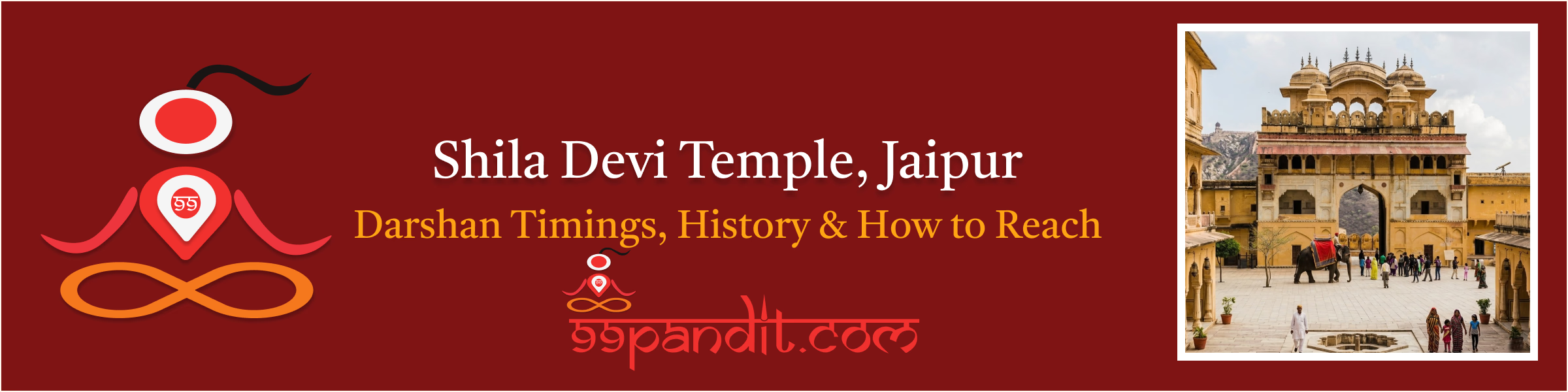
Shila Devi Temple, Jaipur: Darshan Timings, History & How to Reach
Shila Devi Temple, Jaipur, is the house of the famous idol of Goddess Durga located in Amber Fort. There is…
 0%
0%
 Book Griha Pravesh Puja Online
Book Now
Book Griha Pravesh Puja Online
Book Now

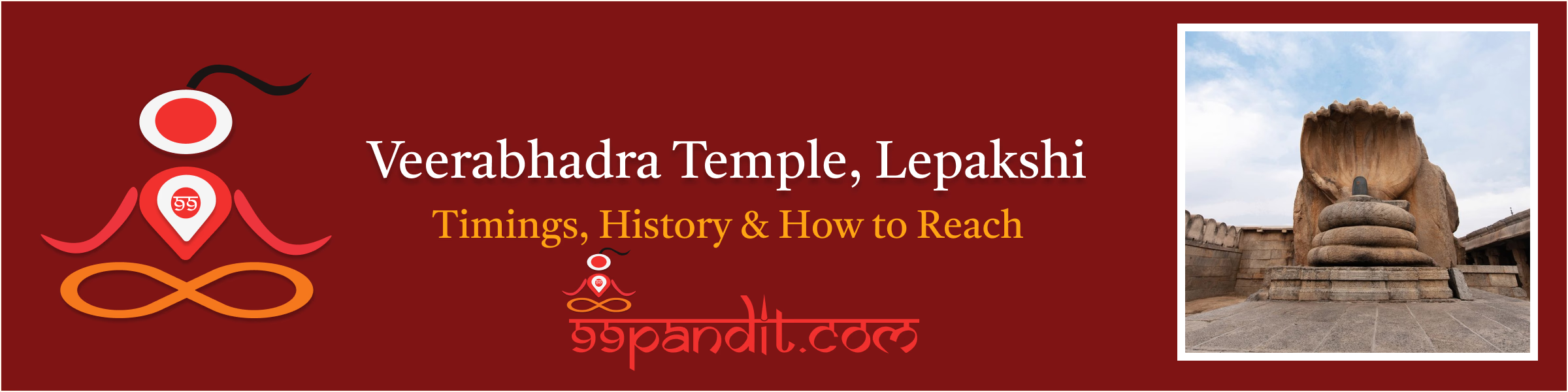


Veerabhadra temple, also called Lepakshi temple, was made in the 16th century by two brothers, Viranna and Virupanna.
They were the governors under the Vijayanagara empire. The temple is dedicated to Lord Veerabhadra, a fierce incarnation of lord shiva.
The legend says that this is the place where Jatayu, the mythical bird from the Ramayan, fell after trying to rescue Sita from Ravan.
‘Le Pakshi’ completely means ‘Rise, bird!’ – the words were believed to be said by Lord Ram to Jatayu.
The temple dates back to 1530 AD, which makes it around 500 years old. Its rich legacy, intricate carvings, and spiritual aura have stood as a testament of time, attracting history lovers, architecture enthusiasts, and pilgrims alike.
Let’s continue reading the article to find out about its history and how to get there.
Lepakshi temple as Veerabhadra temple, is a dedication to Lord Veerabhadra. The temple is located in the small village of Lepakshi in the Anantapur district of Andhra Pradesh.
The development of the sacred place occurred in the 16th century during the reign of the Vijayanagara kings.
The Lepakshi Temple is also a three-shrine temple, which is devoted to the Hindu Gods of Shiva, Vishnu, and Veerabhadra.
This magnificent 16th-century Vijayanagar-style structure contains approximately 70 pillars made of stone.
It is a temple with the largest sculpture of a demon king, Veerabhadra. In addition, the temple is constructed on a low hillock, which is known as Kurmasailam.
Kurmasailam is translated to mean tortoise hill in the Telugu language. Aakaasa Sthambha (Hanging Column) is one of the pillars in the Lepakshi Temple.
This pillar is not lying completely on the ground. In the British times, when a British engineer attempted to move it, his work was useless. Nevertheless, by so attempting, the pillar lost its original position.
Other than the Hanging Pillar, what is also worth viewing is the spectacular Nandi, which is approximately a mile in advance of the principal temple. It is 27 ft long and 15 ft high, which is believed to be the largest monolithic Nandi in India.
| Opening and Closing Timings | 6:00 am – 6:00 pm |
| Entry Fee | No fee |
| Main Deity | Veerbhadra |
| Nearest Airport | Sri Sathya Sai Airport |
| Location | Anantapur district, Andhra Pradesh |
| Photography | Allowed |
Planning a visit to an architectural marvel? Then this essential timing and visitor details for the Veerabhadra temple in Lepakshi help you to plan your trip.
The temple is usually open every day of the week.
Note: Some information advises the temple reopens for evening rituals until 8:30 PM, but for general sightseeing and exploring the architecture, it’s good to come between 6:00 AM and 5:30 PM.
If you want to experience or take part in the rituals, follow the schedule below:
| Category | Details |
| Entry Fee | Free (No tickets required for entry). |
| Best Time to Visit | October to February (The stone floors become very hot in summer). |
| Photography | Only in the outer complex, often prohibited inside the inner premise. |
| Dress Code | Traditional/Formal. It is advised to wear modest clothing (Saris/Salwar Kameez for women; Dhoti or formal trousers for men). |
| Time Required | 2–3 hours to comfortably see the main temple and the Nandi statue. |
Two myths are associated with the name Lepakshi. The first legend says that Ramayana mentions Lepakshi, where Ravana abducted Sita. The bird Jatayu made attempts to rescue her as he was taking her away.
Ravana overpowered him, and he dropped to the ground. As he was taking his last breath, Lord Rama assisted him to achieve Moksha by uttering the words, Le Pakshi, which means Rise Bird, in Telugu. So the name Lepakshi was coined.
Another legend also says that the Vijayanagar Kingdom comprised two brothers named Virupanna and Veerupanna.
The son of Virupanna was blind, and it is said that he got eyesight as he was playing near the Shivalinga in the temple.
One of the Vijayanagar financiers was Veerupanna. People accused him of embezzling the royal treasury.
Some believe this happened during the temple’s completion, while others say it occurred when he healed the king’s son. As a result, the king ordered the removal of his eyes.
Aggravated with the false imputation, he preempted the sentence and cast his eyes on the walls of the temple.
Therefore, it was the place named Lape-Akshi, the village of the blind. The strange thing this time is that the blood marks on the eyes are preserved on the wall of the temple.
It is one of the most remarkable features of the Lepakshi temple, which is the hanging pillar, or Akasha stambha.
Inside the temple, there are approximately 70 pillars, but one special one does not touch the ground.
You can even move a thin cloth or paper under it. People believe that if you move these pillars, others will move too. The mystery confuses engineers.
The temple is developed on a small hill, and two walls cover it. It has three main areas: the dance hall known as the natya mandapa, the middle part is the Ardha mandapa, and the main prayer room called the sanctum.
Just before entering the temple, you will see a huge Garuda statue – the vehicle of Lord Vishnu.
It is in a kneeling position, as if in devotion, and perfectly catered to face the inner premise. This is a beautiful integration of reverence and sculptural artistry.
The huge Nandi statue is a part of the Lepakshi temple and one of the biggest Nandi statues in the world.
This is 27 feet long and 15 feet tall. It faces the Naaglinga in the Veerabhadra temple. There is a small pond near this.
There is a big stone inside the temple with a carving of many-headed snakes covering a linga, such as an umbrella.
Lepakshi temple, found in Andhra Pradesh, is popular for a big 2.5 feet long stone footprint.
Many believe it belongs to either Mata Sita or lord hanuman from the Ramayan. Some historians say it was a full footprint that wore down and made into the shape you see now.
There is also a small lord ganesh temple, and you can find meditation rooms in the corridors.
A unique leafless tree that has been there for many years, and many more interesting things are there that show the talent of ancient architects.
Originally, the puja of the Shivalinga is performed. Lord Veerabhadra is thus worshipped.
During the morning, the lord is seen in Bala rupa (youth). And becomes a hero in a moustache by night.
Devotees do the Abhishek to Lord and Mother and present clothes. Devotees offer sacrifices in the form of sweet pudding, Sarkarai Pongal Nivedhana.
The temple presents the Sadari blessing with the Lord’s lotus feet, similar to Lord Vishnu temples. The temple also serves betel leaves as prasad to devotees.
In the Lepakshi temple, the month of February is celebrated with a 10-day-long festival.
It includes the car festival. During this time, the visitors come in large numbers to visit the temple.
Mahashivratri: This is the most favorite day of lord shiva, on which the temple organizes a big fair.
In this many sweetmeats, clothes, bangles, toys, or bamboo traders are invited. Also, the trading of domestic animals such as cows, goats, etc participate in temple fairs. Although a lot of villagers come on the day to receive blessings.
Durgamma Festival: It is a festival that lasts four days and occurs in the month of Bhadrapada of the Hindu Calendar.
On this day, believers bring water to the river Majira to worship. Besides, numerous other sacrifices are also made during this time. On this day, temple authorities hold a fair.
The other festivals that require celebrations in the Lepakshi temple are Masi Brahmmotsavam during the months of February-March and Tirukarthikai during the months of November-December.
Lepakshi is just 120 kilometers from Bangalore, which makes it a perfect place to start your journey, a 2.5 to 3-hour drive one way.
Transport Options:
The perfect time to visit the temple is from October to February, when the weather is pleasant and walking through the temple doesn’t feel like a punishment.
Prevent visiting in summer afternoons unless you are cool with 40°C heat. Weekdays are quite good, but you may experience dodgy crowds.
The Veerabhadra Temple of Lepakshi is much more than a place of worship; it is an Indian living gallery to its rich artistic and engineering history.
The temple stands as a silent monument to the highest level of Vijayanagara craftsmanship, in the hanging pillar, which defies gravity, and in the extensive, colourful frescoes which cover its ceilings.
All the weathered granite of it is storytelling stuff of devotion, mystery, and unsurpassed prowess.
It is either the spiritual ambiance of the inner sanctum, or the mythical stature of the monolithic Nandi, or the elaborate mythology hewn into its stone-lined corridors, Lepakshi is something of a rarity in a golden age of history.
It attracts anyone who wants to experience the ancient Indian spirit.
The temple, as the sun goes down on the rocky horizon, is not only a monument, but a master work that is permanent, cut in stone.
Table Of Content
 Number.

Enter the OTP sent to
Chat with verified astrologers on 99Pandit and receive personalized guidance for every stage of life.


 Ontime Service
 Certified Pandit
 Transparency