Griha Pravesh Muhurat in 2026: Auspicious Dates, Timings & Significance
Griha Pravesh Puja is one of the most important pujas in the Hindu religion. Griha Pravesh Muhurat 2026 and Griha…
 0%
0%
 Book Griha Pravesh Puja Online
Book Now
Book Griha Pravesh Puja Online
Book Now

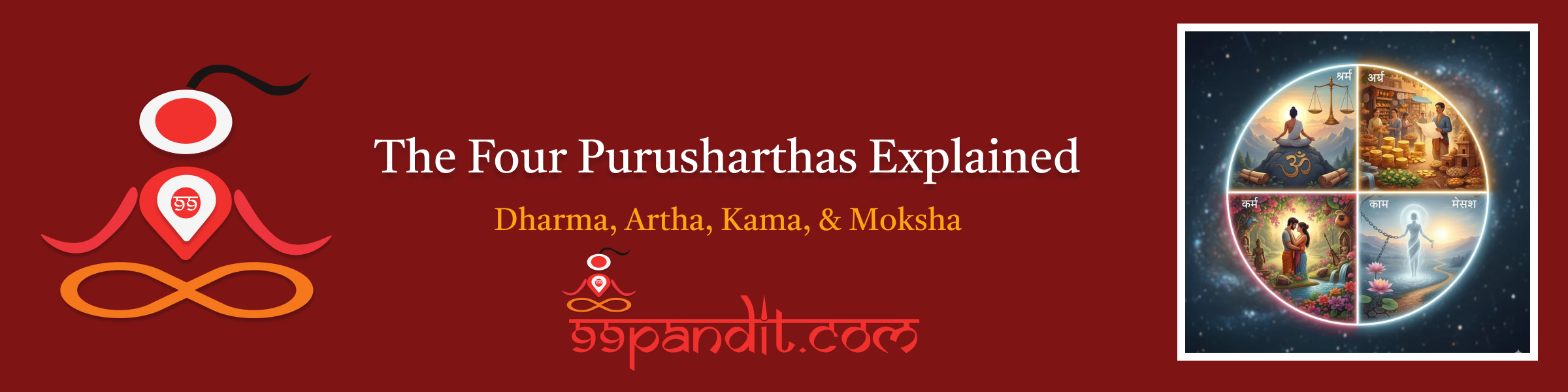


In human lives, they have different types of desires and goals, which are described as the four Purusharthas.
They keep working hard to obtain their goals (Purusharthas). Usually, people cannot distinguish between their desire and their real plans.
Thus, they struggle in their life because of ignorance of wishes, and a blind mind may create a sin.
Greed and desires are believed to be the root of all sins. Purusharthas means ‘purpose of man’ in Sanskrit, where Pursha means a ‘human’ and Artha means ‘an object or goal’.
The hindu style of life shows that a man must make his life’s work to achieve the four main objectives: Dharma (righteousness), artha (material wealth), Kama (desire), and moksha (salvation) are the first four.
It advises that a life well-lived isn’t about selecting between the material and spiritual, but about merging them.
Through a detailed guide, we will explain all Purushartha one by one, knowing their meaning, place in modern life, and how you can implement them in your life to balance routine and mindset.
The term Purushartha is composed of two words – Purusha and Artha. There are four main objectives of human life as mentioned in Sanatan Dharma: Dharma (Righteous Living), Artha (Wealth & Resources), Kama (Desires & Pleasure), and Moksha (Liberation).
But you know what makes Sanatan Dharma significant is that it does not reject any of them? It never says ‘Only moksha matters, everything else is waste’, nor does it say ‘just enjoy and forget spirituality’.
Rather than, it displays a balanced path where you achieve, enjoy, serve, love, and remain to move slowly and consistently towards inner freedom.
Consider Purusharthas as a religious compass. Whenever you are confused – about career, relationships, life decisions, and money – you can ask yourself:
The more you cater to these doubts,
the calmer and clearer you will find. Now, let us know more about these four.
| Purushartha | Literal Translation | Core Focus | Modern Equivalent |
| Dharma | Law, Duty, or Righteousness | Ethics, values, and social responsibility. | Purpose & Integrity |
| Artha | Prosperity or Wealth | Financial security and material resources. | Career & Success |
| Kama | Desire or Pleasure | Sensual joy, love, and aesthetic beauty. | Passion & Emotional Health |
| Moksha | Liberation or Freedom | Spiritual awakening and self-realization. | Enlightenment & Inner Peace |
In the hierarchy of Purusharthas, Dharma is known as the most critical. This is a ‘moral compass’ that assures the purpose of wealth and pleasure does not lead to chaos or self-devastation.
Founded from the Sanskrit root dhri (to uphold or support), Dharma is something that upholds the cosmic order and individual soul.
This is usually termed as ‘duty’, but its core meaning is much bigger- it holds ethics, law, virtue, and social duties.
To live following the dharma, to live in a way that is ‘in tune’ with the natural universe laws.
So, dharma is not one-size-fits-all for a set of rules. It works on two distinct levels:
Living by Dharma in the modern world, it can look like completely simple daily decisions:
Whenever you take the side of truth and fairness, even if it’s not convenient, you are standing with Dharma.
Shiva, Rudraksha & Dharma:
Lord Shiva in hindu philosophy is known as the silent witness – the revealer of cosmic dharma. His vibrations show truth, balance, and inner clarity.
Rudraksha, considered to be born from Shiva’s tears, carries an energy that supports steadiness, concentration, and mental purity.
The followers who go through the path of Dharma usually use Rudraksha as a spiritual gemstone to be grounded and catered to during life’s obstacles.
When practices are associated with truth, the mind becomes calm, and quiet strength occurs – the power of knowing ‘I am connected with divine law’.
However, many spiritual frameworks avoid the material world; the Purusharhtas adapt it.
Artha responds that to live a life full of dignity and to satisfy our responsibilities, we need resources.
Artha translates to the means of life. This encompasses financial security, shelter, food, and the professional equipment needed to flourish.
It is the desire towards economic prosperity and the ability to make a difference in the world.
Artha was considered a necessity in ancient literature since an individual who finds it hard to survive cannot comfortably dwell on some spiritual realities.
The purpose of wealth is not a ‘free-for-all’. To be believed a true Purushartha, Artha should be followed within the restrictions of Dharma.
In the landscape of 2026, we can redevelop Artha as Financial Wellness. ‘Sustainability: Artha presently consists of making decisions that assure the longevity of our planet’s resources.
Some particular Rudrakshas in Vedic astrology and spiritual science are connected with stability, confidence, and financial growth. For example:
Yet, no Rudraksha or gemstone can support Artha if one’s actions are completely against dharma. The outer tools when the inner intent is catered to and sincere.
Kama is possibly the most misunderstood concept of the four objectives. Usually lessened to mere physical intimacy, this is the true extent, which is much broader, containing the whole spectrum of human emotion and sensory experience.
Kama is the thirst of enjoying pleasure in its simplest nature. This involves the love between couples, the family bond, appreciation of music and art, and even the simple pleasure of a well-prepared meal. It depicts the psychological and emotional well-being of a human being.
A lot of people mistakenly believe Purusharthas need the suppression of wishes. On the opposite, the pattern suggests that:
A basic principle of the philosophy is that you cannot exceed what you have not first apprehended and integrated.
Some Rudraksha combinations are traditionally applied to balance the emotions and the heart and stabilize the desires:
Again, these are supported. It is only the conscious decision to live in awareness and responsibility in your relationships and desires that brings about the actual change.
And the final destination of the human life journey – Moksha. The first three goals (Dharma, Artha, and Kama) aim on living a good life in the world, whereas Moksha concentrates on the soul’s eternal journey from the world.
Moksha is derived from the Sanskrit root muc, which means ‘release’ or ‘let go away’. It shows the liberation from Samsara – the regular cycle of birth, death, and rebirth.
According to psychological sense, this is the state of being completely free from fears, attachments, and ego-driven wishes that drive human suffering.
The sacred wisdom advises that, as every human is distinct, there are many ‘highways’ to reach the state of liberation:
A general misconception is that liberation only occurs after death. Yet, the custom describes Jivanmukta – one who is ‘get moksha while living’.
This is an individual who still connects with Artha, Kama, and Dharma, but does so with total inner detachment.
They are in the world, but not from the world, containing an unshakable peace apart from external conditions.
Definitely, in fact, a lot of householders are now greatest saints – they completed dharma, achieved artha, lived kama responsibilities, and still moved consistently towards Moksha. The Sanatan Dharma does not ask anyone to become a saint. It says:
‘Start from there, wherever you are. Make your family, your work, your tasks – your objective.
The concept of Purusharthas tells us that moksha is not different from life; this is the ultimate flowering of a life lived in balance.
When dharma leads you, artha supports you, kama does not control you, then Moksha naturally becomes your inner guide.
The greatest symbol of Moksha is Lord Shiva Vairagya (detachment), awareness, and silence.
Rudraksha is also thought to be a direct benediction of Shiva to those who want to attain liberation.
The more Mukhi Rudraksha one has (such as 11 Mukhi, 12 Mukhi, 13 Mukhi, and so on), the more spiritual awakening is believed to be, bolder in sadhana, and breaking old karmic habits.
Daily japa using a Rudraksha mala, reciting mantras such as Om Namah Shivaya, Mahamrityunjaya Mantra, and leading a life with a pure purpose to become spiritual, gradually cleanses the mind and makes it ready for Moksha.
Purusharthas’s one of the most beautiful details is that it does not require that you avoid any part of life. Instead, it teaches you harmony.
Artha and Kama are hazardous when there is no Dharma. Once forgotten about Moksha, life will be the same, a never-ending circle of chasing something more money, more comfort, more status, but never being satisfied.
And when Artha or Kama is not natural, then the mind becomes frustrated, and thus unbalanced.
Sanatan Dharma informs us: Live, but live wisely. Earn, enjoy, love, create, but never forget – I am a spiritual entity experiencing a human experience and not the other.
Sit quietly for some time at the end of the day and ask yourself:
The simple questions themselves can change your awareness and bring immense clarity into your life choices.
In whatever job you are – business, healing, teaching, service, art – ask:
An aligned career with dharma may still have complications, but it will support you to achieve inner satisfaction that no salary slip alone can match.
Make a little prayer mission with your money: “A portion of all that I earn will be given to some dharmic purpose, feeding, temple seva, education, or someone in need.
Some of the tiniest percentages that are always done alters the vibration of your Artha.
Invest in things that bring more sattva (purity) to your life too (spiritual books, puja materials, Rudraksha, gemstones, courses that make you feel good, or even travel to religious sites).
These are not costs; these are investments into your inner development.
Regardless of fighting your desires with guilt, watch them with awareness. Question: ‘Is this wish coming from your insecurity, ego, or loneliness? Or is it a healthy representation of joy, creativity, and love?’
Pick relationships that support your emotional and religious growth. Value your own boundaries and other restrictions too. Open your heart, but also wisely.
You do not need to renounce everything to proceed further in Moksha. Begin with just these simple steps:
These small things gradually cleanse your mind, making it ready for deeper realizations.
The Four Purusharthas make us realize that a good life is not a one-sided affair. There is no need to decide to remain a successful professional and a spiritual seeker.
That way, by combining Dharma, Artha, Kama, and Moksha, you end up having a life of depth as opposed to a life of being busy and a life of being profitable.
It is the primordial structure, which offers the final trade-off: it grants us the license to enjoy the world (Artha and Kama), and the intelligence on how to live in it (Dharma), all the time keeping our eyes on the ultimate reward of inner freedom (Moksha).
When these four ends are in balance, then the outcome is a feeling of completeness- a life of regretless living.
Table Of Content